


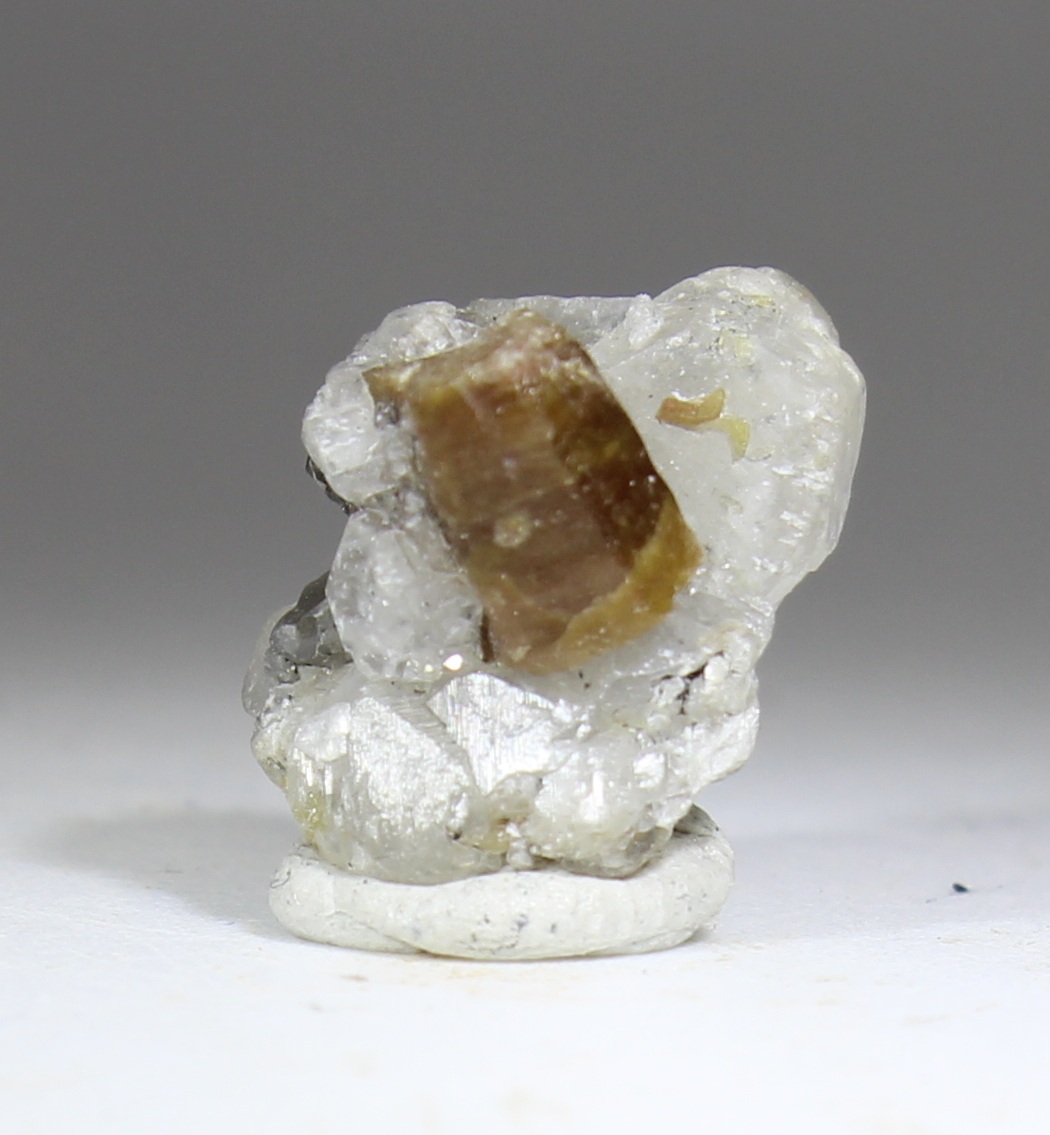
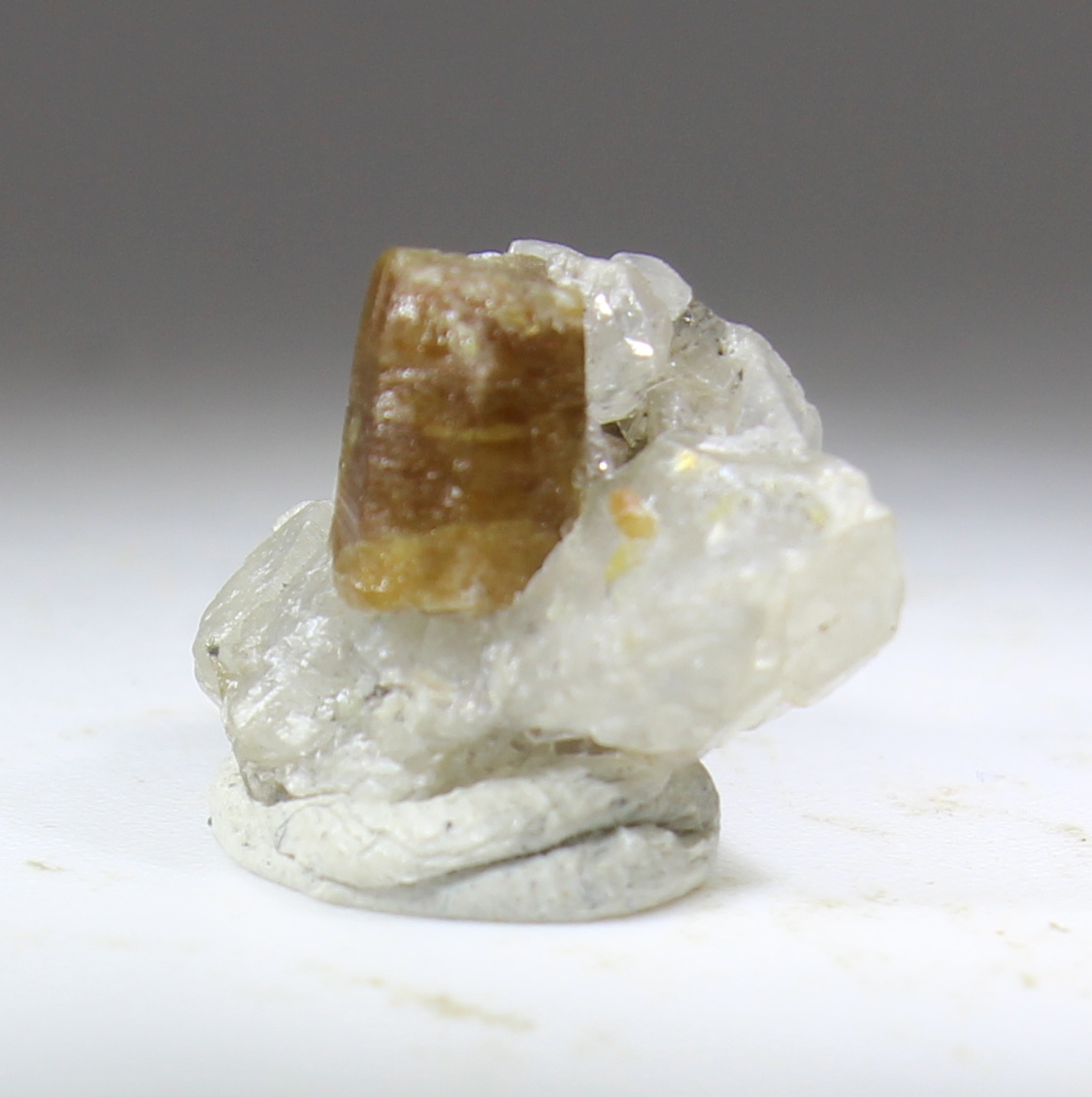

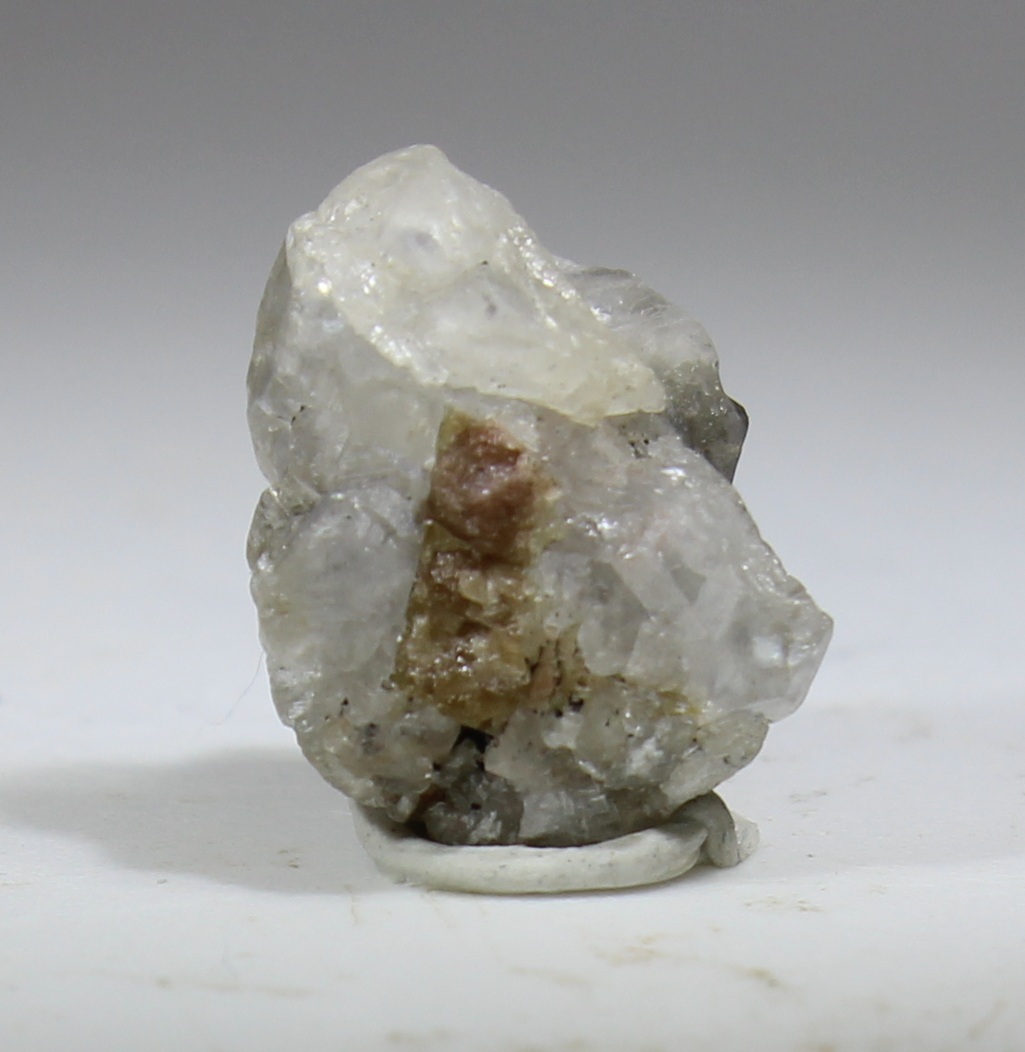
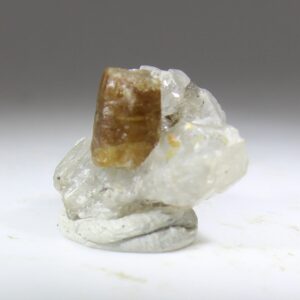

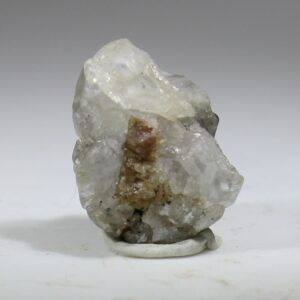
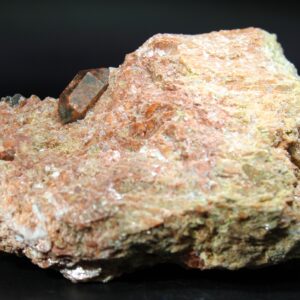
This small Parisite-(Ce) specimen from Muzo, Colombia features an approximately 6 mm long brown Parisite-(Ce) crystal clearly positioned on a light-colored calcite matrix. Despite the compact size of the specimen, the crystal stands out distinctly from the surrounding calcite and shows a recognizable prismatic form with a well-preserved termination.
Of particular interest is the natural intergrowth of the Parisite-(Ce) with the matrix. The crystal is not simply resting on the surface, but is visibly incorporated into the calcite mineralization. This preserves the original paragenetic context of the mineral far better than an isolated crystal.
Parisite-(Ce) crystal with preserved termination
The approximately 6 mm long Parisite-(Ce) crystal has a brown to yellowish-brown color. Its prismatic form is clearly visible, and one side shows a well-preserved termination.
The crystal faces display a slightly irregular surface texture. Nevertheless, the contrast between the brown Parisite-(Ce) and the colorless to white calcite makes the crystal easy to distinguish from the surrounding matrix.
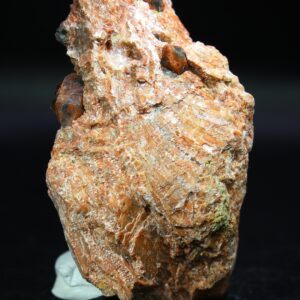
Several transparent to translucent calcite areas surround the Parisite and form a compact matrix. The side and rear views in particular show how the crystal is directly intergrown with the calcite.
Parisite-(Ce) from the type locality of Muzo
Muzo in Boyacá, Colombia, is the type locality of Parisite-(Ce). This rare calcium-cerium fluorocarbonate was originally described from the famous Colombian emerald district and occurs there as part of the hydrothermal vein mineralization. Parisite-(Ce) can occur together with calcite and other minerals associated with the emerald deposits.
Parisite-(Ce) on matrix is particularly interesting to collectors because the natural relationship with the accompanying mineral is preserved. Unlike isolated crystals, matrix specimens retain the original mineralogical context of the locality and show how the Parisite crystallized within the vein mineralization.
With dimensions of 1.5 × 1.0 × 0.9 cm, a weight of 1.8 g, and an approximately 6 mm long Parisite-(Ce) crystal, this is a compact Micromount specimen from a mineralogically important classic locality.
More about Parisite-(Ce) from Muzo, its locality, and the mineralogical significance of the type locality can be found in my detailed article.
| Feature | Details |
|---|---|
| Mineral | Parisite-(Ce) |
| Mineral group | Carbonates |
| Locality | Muzo, Boyacá, Colombia |
| Type locality | Yes – Muzo is the type locality of Parisite-(Ce) |
| Dimensions | 1.5 × 1.0 × 0.9 cm |
| Weight | 1.8 g |
| Size Category | Micromount |
| Parisite-(Ce) crystal size | approx. 6 mm |
| Color | Brown to yellowish-brown |
| Crystal habit | Prismatic |
| Matrix | Colorless to white calcite |
| Transparency | Opaque |
| Special Feature | Parisite-(Ce) crystal with well-preserved termination, naturally intergrown with the calcite matrix |
| Mineral | Calcite, Parisite-(Ce) |
|---|---|
| Color | Brown |
| Size | Micromount (less than 1.5 cm) |
| Continent | South America |
| Country | Colombia |
| Feature | Acquired On Site, Classic locality, Type locality |
Be the first to review “Parisite-(Ce) on Calcite from Muzo, Colombia – Crystal on Matrix”
Related products
No VAT is shown in accordance with Section 19 (1) of the German VAT Act. Shipping costs apply.
plus shipping costs
No VAT is shown in accordance with Section 19 (1) of the German VAT Act. Shipping costs apply.
plus shipping costs
No VAT is shown in accordance with Section 19 (1) of the German VAT Act. Shipping costs apply.
plus shipping costs
No VAT is shown in accordance with Section 19 (1) of the German VAT Act. Shipping costs apply.
plus shipping costs
Colombia
No VAT is shown in accordance with Section 19 (1) of the German VAT Act. Shipping costs apply.
plus shipping costs
No VAT is shown in accordance with Section 19 (1) of the German VAT Act. Shipping costs apply.
plus shipping costs
No VAT is shown in accordance with Section 19 (1) of the German VAT Act. Shipping costs apply.
plus shipping costs
No VAT is shown in accordance with Section 19 (1) of the German VAT Act. Shipping costs apply.
plus shipping costs
Reviews
There are no reviews yet.