

Localities
Parisite-(Ce) from Muzo – A Rare Associated Mineral of Colombian Emeralds
Aug
Parisite-(Ce) is one of the most fascinating associated minerals found in Colombia’s emerald deposits. The Muzo District is especially important: it is not only world-famous for its emeralds, but also the type locality of Parisite-(Ce). This article explores the mineralogy, crystal forms, occurrence, and selected Parisite-(Ce) specimens from my own collection.
More Than Emeralds
The Muzo District in the Department of Boyacá is best known worldwide for its emeralds. Together with the mining districts of Peñas Blancas, Yacopí, Maripí with the La Pita Mine, and Coscuez, Muzo forms part of Colombia’s Western Emerald Belt, one of the world’s most important emerald-producing regions [1].
Less well known is that the deposits of Muzo have produced not only emeralds, but also a number of exceptional associated minerals. One of the most mineralogically interesting is Parisite-(Ce), a rare rare-earth fluorocarbonate that can occur together with hydrothermal emerald mineralization in the Colombian deposits [1]. For a more detailed look at Colombia’s emerald regions, their geology, and my visits to Muzo, Coscuez, Chivor, and Gachalá, see my travel report on the Colombian emerald regions.
What Is Parisite?
The name Parisite refers to a group of closely related rare-earth fluorocarbonates. The group includes the mineral species Parisite-(Ce), Parisite-(La), and Parisite-(Nd). The individual species are distinguished primarily by which rare-earth element dominates the corresponding sites within the crystal structure [1].
Parisite-(Ce)
Of particular importance in the Colombian emerald deposits is Parisite-(Ce). In this mineral species, cerium is the dominant rare-earth element. Parisite-(Ce) has the idealized chemical formula CaCe₂(CO₃)₃F₂ [1, 2].
The historic Parisite from the Muzo emerald district corresponds to the mineral species now known as Parisite-(Ce). Muzo, or more specifically the Muzo Mine, is listed as the type locality or co-type locality of the mineral [2].
Mineralogical Properties of Parisite-(Ce)
Parisite-(Ce) crystallizes in the monoclinic crystal system, but commonly develops a pronounced pseudohexagonal habit. This apparent higher symmetry can result, among other factors, from complex stacking sequences and intergrowths with structurally related rare-earth fluorocarbonates [1, 2].
| Property | Parisite-(Ce) |
|---|---|
| Chemical Formula | CaCe₂(CO₃)₃F₂ |
| Crystal System | Monoclinic |
| Color | Brown, brownish yellow, waxy yellow to grayish yellow |
| Transparency | Transparent to translucent |
| Luster | Resinous to pearly |
| Mohs hardness | Approx. 4.5 |
| Density | Approx. 4.33–4.39 g/cm³ |
| Cleavage | Distinct to good |
| Fracture | Brittle |
| Crystal habit | Pseudohexagonal, commonly appearing prismatic to pyramidal; also scepter-like forms |
With a Mohs hardness of about 4.5, Parisite-(Ce) is considerably softer than emerald. At the same time, its high content of rare-earth elements gives the mineral a comparatively high density of approximately 4.33 to 4.39 g/cm³ [1, 2].
A particularly characteristic feature is the frequently pseudohexagonal appearance of the crystals. Complex intergrowths and different stacking sequences within the REE fluorocarbonates can produce strongly striated crystals with apparently prismatic or scepter-like forms. In Colombian material in particular, such intergrowths can make definitive identification more difficult [1].
Discovery and Naming of Parisite-(Ce)
The history of Parisite is directly linked to the emerald mines of Muzo. The first description of “Parisite” dates to the mid-19th century and was based on a specimen from the Muzo emerald district in the Department of Boyacá [1].
The mineral was named after José Ignacio París Ricaurte, who was associated with the operation of the Muzo emerald mines during the 19th century and leased the mine from 1828 to 1848. The name Parisite therefore directly reflects the history of emerald mining in Colombia [2].
Muzo consequently holds particular mineralogical importance for Parisite-(Ce). Both the Muzo district and the Muzo Mine are listed as co-type localities of the mineral species [2].
For a long time, the Colombian occurrence remained exceptional, with additional occurrences of Parisite not becoming known until after 1890. Today, Parisite-(Ce) is also known from various igneous and carbonatite-related deposits in other parts of the world. The Colombian occurrence, however, represents a geologically distinctive setting, as Parisite-(Ce) occurs here in hydrothermal vein and cavity mineralization hosted by carbon-rich sedimentary rocks [1].
Parisite-(Ce) in the Colombian Emerald Deposits
In Colombia, Parisite-(Ce) is primarily associated with the emerald deposits of the Western Emerald Belt. This belt includes the districts of Muzo-Quipama, Coscuez, Maripí, Peñas Blancas, Pauna, and Yacopí-La Palma, among others. Within the hydrothermal veins and breccias of these deposits, Parisite-(Ce) occurs as a minor associated mineral together with calcite, dolomite, pyrite, fluorite, apatite, quartz, and emerald [3].
Parisite-(Ce) is particularly well documented from the Muzo area and the La Pita Mine near Maripí. A detailed mineralogical study of material from La Pita describes Parisite-(Ce) occurring together with emerald mineralization in organic-rich black shales. In the Western Emerald Belt, Parisite-(Ce) is interpreted as part of a later hydrothermal mineralization stage in which emerald, fluorite, apatite, and quartz also crystallized [1,3].
For Muzo, this relationship has been studied particularly well. Parisite-(Ce) not only occurs within the same hydrothermal system as emerald; studies also indicate a textural equilibrium between Parisite-(Ce) and emerald. The rare-earth elements required for the formation of Parisite appear to have been mobilized, at least to a significant extent, from the surrounding dark sedimentary rocks [4].
Interestingly, however, Parisite-(Ce) is not strictly confined to the Western Emerald Belt. More recent studies of the hydrothermal evolution of Colombia’s emerald deposits also identify Parisite-(Ce) as a trace mineral of the second mineralization stage across Colombian emerald districts and emphasize the broadly similar geochemical evolution of both belts [3]. This suggests that Parisite-(Ce), or related REE fluorocarbonates, may also occur in the Eastern Emerald Belt, which includes Gachalá, Chivor, and Macanal.
How Does Parisite-(Ce) Occur in Muzo?
In the Muzo District, Parisite-(Ce) occurs within the hydrothermal vein and cavity mineralization hosted by Lower Cretaceous, organic-rich black shales. Parisite-(Ce)-bearing veins may also contain calcite, albite, pyrite, quartz, fluorite, and emerald. Studies of samples from the Muzo area document Parisite-(Ce) particularly in emerald–Parisite–calcite–albite veins cutting through the dark, graphite-rich host rock [4].
Parisite-(Ce) is assigned to a later stage of hydrothermal mineralization. Several mineralization stages are distinguished within the Western Emerald Belt. During this later stage, minerals including emerald, Parisite-(Ce), pyrite, dolomite, fluorite, and quartz crystallized. Parisite-(Ce) and emerald have been observed in textural equilibrium, suggesting that the two minerals crystallized at least partly at the same time from the same hydrothermal system [4].
Parisite-(Ce) can occur in a variety of forms. In addition to small crystals and inclusions within emerald, well-developed free-standing crystals may occur in vein cavities and pockets. Colombian material is commonly described as forming prismatic to barrel-shaped crystals with a pseudohexagonal appearance. Distinct transverse striations on the apparent prism faces are a characteristic feature. In studied material, the color ranges from brown to reddish brown, while under artificial lighting the crystals may appear noticeably more yellowish [1].
Of particular mineralogical interest is the fact that Parisite-(Ce) crystals that appear uniform externally may be considerably more complex internally. Studies of material from the La Pita Mine have revealed syntaxial intergrowths of Parisite-(Ce) with Röntgenite-(Ce) and other REE fluorocarbonate phases, as well as different stacking sequences within individual crystals [1]. As a result, the exact identification of such crystals is not always possible from their external morphology alone.
The unusually large and well-developed crystals that can occur in the Muzo area are probably the result of several favorable factors acting together rather than a single cause. Important conditions likely included a sufficient supply of calcium, carbonate, fluorine, and rare-earth elements in the hydrothermal fluids, combined with the presence of open veins and cavities. Geochemical studies indicate that the required rare-earth elements were largely mobilized through interaction between the fluids and the surrounding black shales [4]. Open cavities locally allowed relatively unrestricted crystal growth. The exceptional size of some Parisite-(Ce) crystals from Muzo should therefore be understood as the result of particularly favorable local growth conditions rather than as a general characteristic of the mineral [4].
Crystal Forms of Parisite-(Ce) from Muzo
Parisite-(Ce) from Muzo can develop crystals of quite varied morphology. Typical are pseudohexagonal crystals with prismatic to pyramidal terminations, whose apparently high symmetry does not correspond to the mineral’s actual monoclinic crystal system. The crystals commonly show distinct transverse striations on the side faces, which can give them a somewhat barrel-shaped or slightly segmented appearance. More compact crystals and scepter-like growth forms also occur [1].
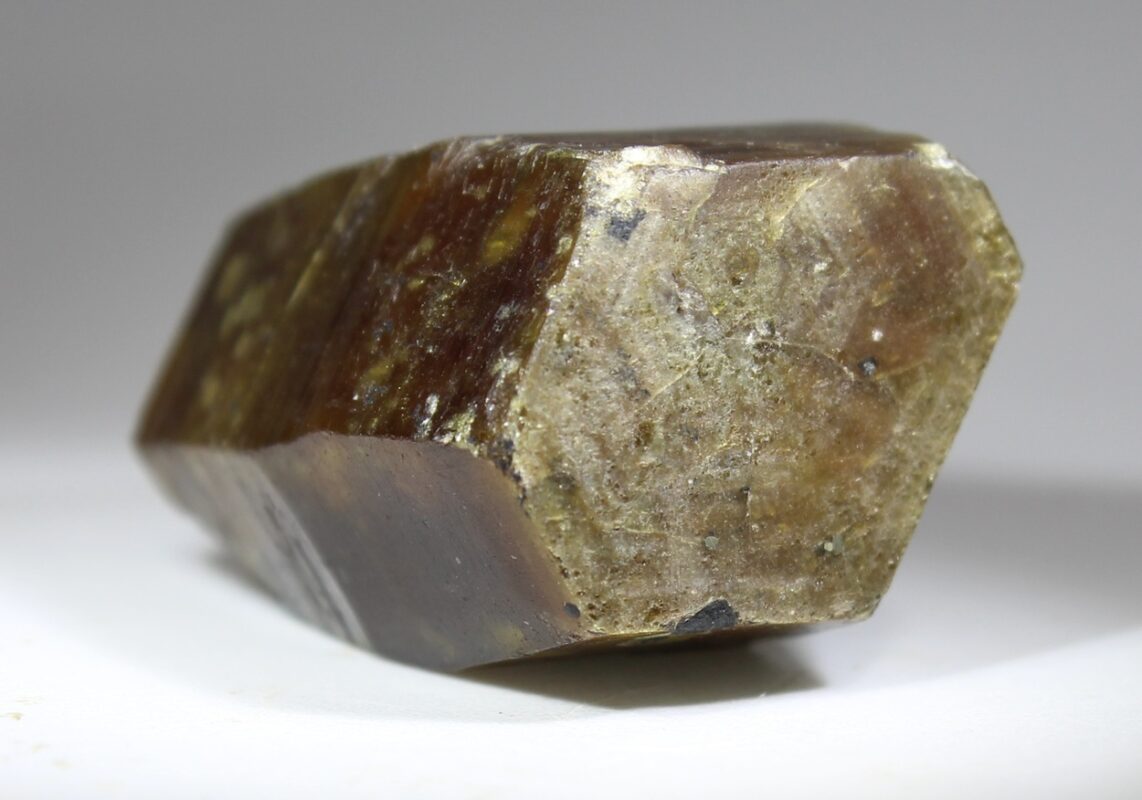
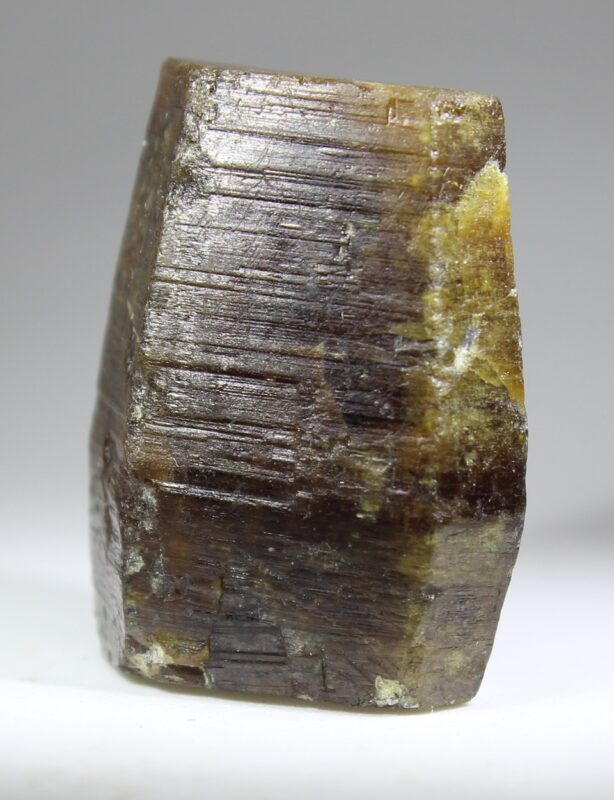
A particularly good example is a large Parisite-(Ce) crystal from my collection. At about 3 cm in length, it already ranks among the unusually large crystals of this mineral from Muzo. The crystal shows an elongated pseudohexagonal form with well-developed side faces. Especially striking is the different development of the two ends: while one termination is very well formed and clearly defined, the opposite end is less completely developed. This makes the specimen a good illustration of the fact that crystal growth did not take place under identical conditions on all sides.
Especially in larger crystals, it becomes clear that the external habit of Parisite-(Ce) can be considerably more complex than its seemingly regular overall form initially suggests. Interruptions in growth, contact with the matrix or other vein minerals, and variations in growth conditions can produce asymmetrical terminations and uneven development of crystal faces. The crystal therefore provides a particularly clear example of how variable Parisite-(Ce) can be when crystallizing within the hydrothermal cavities of Muzo.
In addition to elongated pseudohexagonal crystals, Muzo also produces more compact, barrel- to pear-shaped forms as well as scepter-like growth forms. In the latter, a later growth stage becomes broader than the underlying crystal body. Such oscillatory and scepter-like forms may be associated with complex intergrowths of different REE fluorocarbonates [1].
Parisite-(Ce) from Muzo – Selected Specimens
During my travels through Colombia, I also spent several days in Muzo. There, I had the unusual opportunity to acquire a lot containing several Parisite-(Ce) crystals. Some of these specimens are now available in the shop, while others are presented in the showroom. This makes it possible to compare different crystal forms and appearances of the mineral directly.
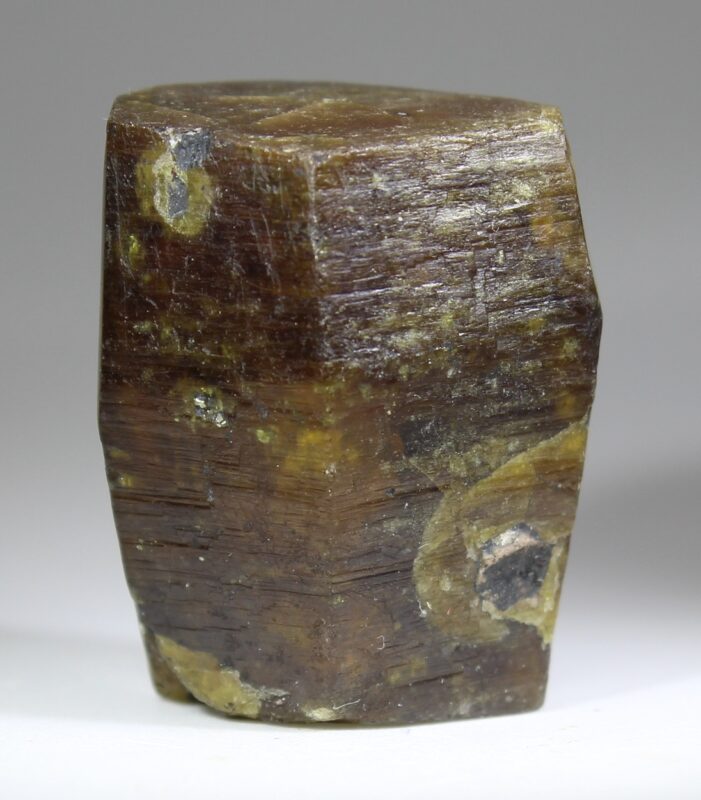
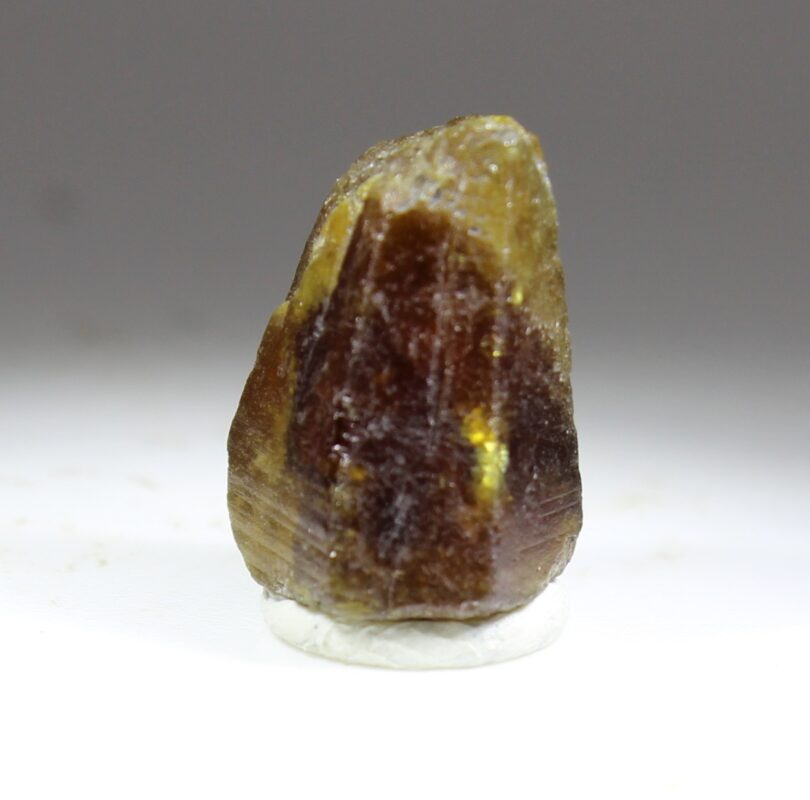
The vast majority of the crystals in my collection are little more than one centimeter in size and show a compact prismatic habit. Some display color zoning, ranging from yellowish and honey-colored tones to reddish brown. The most typical color, however, is brown. A representative example is this specimen, weighing approximately 3 g.
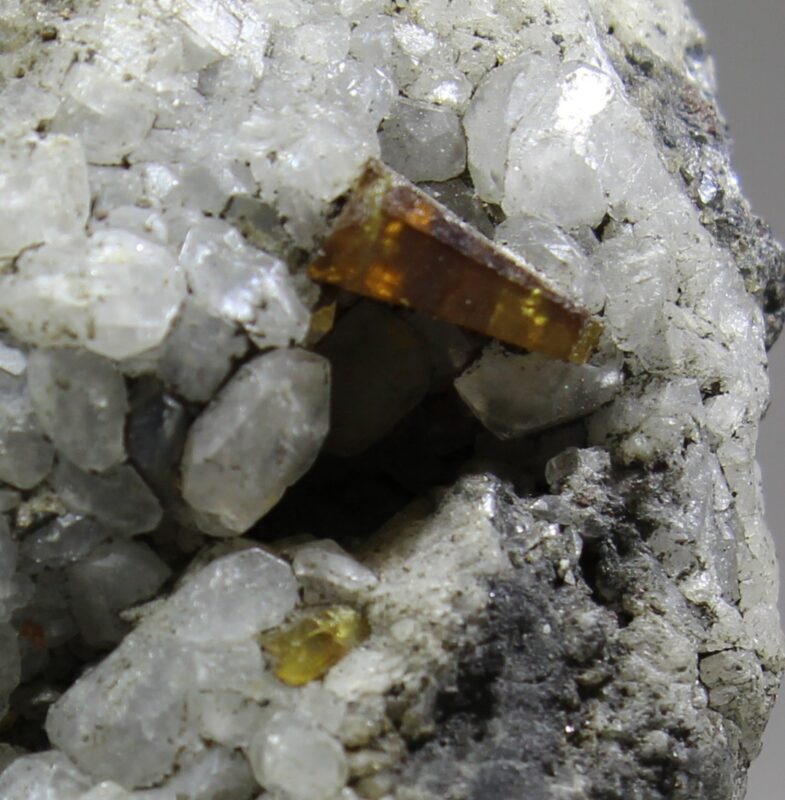
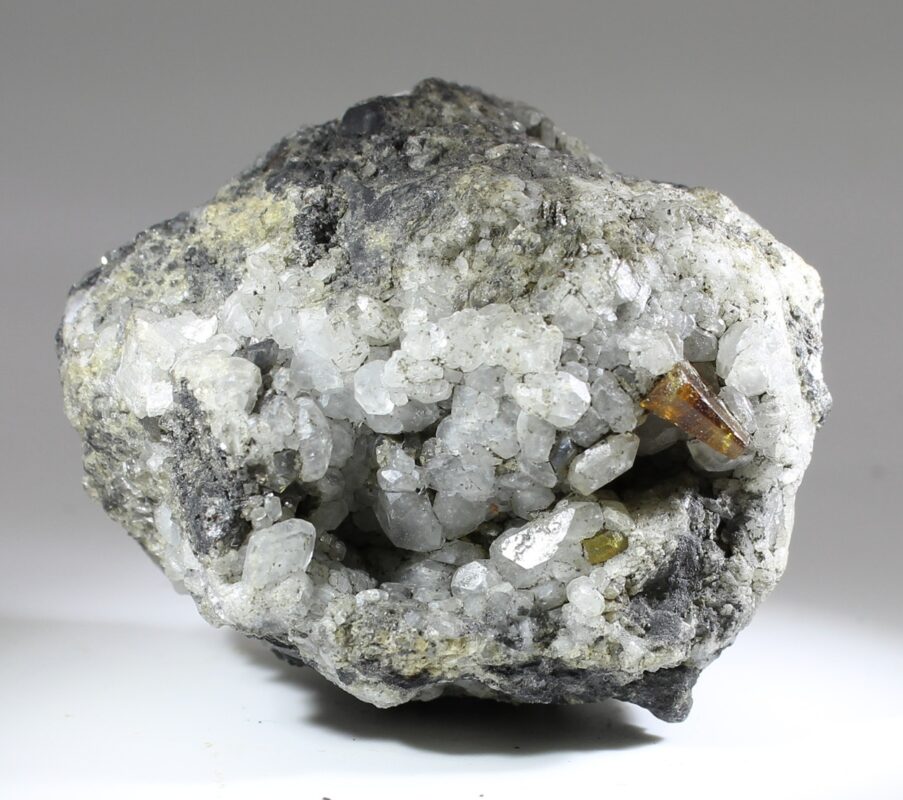
My collection also includes a matrix specimen with an approximately 7 mm transparent Parisite-(Ce) crystal. Although the crystal is considerably smaller, the specimen is particularly illustrative because of the contrast between the free-standing crystal and its matrix. Such matrix specimens also preserve the original geological context far better than isolated crystals and demonstrate how Parisite-(Ce) can occur within hydrothermal vein mineralization. Occasionally, Parisite-(Ce) even occurs together with emerald. Specimens displaying both minerals in an attractive paragenesis, however, are exceptionally rare.
This 3 cm tall Parisite-(Ce) crystal from the showroom is a true highlight of my collection. For this mineral, a crystal of this size already represents a remarkable development. The specimen shows the elongated, pseudohexagonal form typical of Parisite, with clearly developed crystal faces. One termination is very well formed, while the opposite end is less completely preserved.
Parisite-(Ce) from Muzo Compared with Other Localities
Parisite-(Ce) is now known from a number of localities worldwide. Documented occurrences include the Mountain Pass carbonatite deposit in California, the Amba Dongar carbonatite complex in India, the Snowbird Mine in Montana, the Mount Malosa pluton in Malawi, and the large Bayan Obo REE deposit in China [1].
Geologically, however, Muzo differs markedly from many of these occurrences. Worldwide, Parisite-(Ce) is commonly associated with alkaline igneous rocks and carbonatites. In the Colombian emerald deposits, by contrast, there is no such direct magmatic association. Here, Parisite-(Ce) crystallized from hydrothermal fluids in veins and cavities hosted by organic-rich sedimentary rocks. This sediment-hosted hydrothermal origin is one of the features that makes the Muzo occurrence particularly unusual [1, 4].
Muzo also holds a special place among mineral collectors. At some other deposits, Parisite-(Ce) forms part of large REE mineralization systems and may occur only as small or inconspicuous grains. The Muzo District, however, has produced well-developed free-standing crystals, some reaching several centimeters in size. Parisite-(Ce) can also occur together with emerald. This combination of unusual geological origin, well-developed crystals, and type-locality status makes Muzo one of the most mineralogically significant localities for Parisite-(Ce) [1, 4].
Conclusion
In Muzo, Parisite-(Ce) inevitably stands in the shadow of emerald. Nevertheless, it is one of the most mineralogically remarkable associated minerals of the deposit. Its significance lies not only in its rarity and the sometimes exceptionally well-developed crystals, but also in its close connection to the history of the locality.
As the type locality of Parisite-(Ce), Muzo holds a special position. The mineral was first scientifically described from this area, and some of the most impressive crystals known today still come from Colombia’s Western Emerald Belt. At the same time, Parisite-(Ce) illustrates just how complex the hydrothermal mineralization of the emerald deposits actually is—and that these deposits have produced far more than emerald alone.
The variety of crystal forms, the occasionally considerable crystal sizes, and the rare association with emerald make Parisite-(Ce) especially interesting to collectors. For me personally, it is therefore one of the most fascinating mineralogical specialties of Muzo, even though it remains far less well known outside the mineral-collecting community than the famous green beryls.
References
[1] Zeug, M.; Nasdala, L.; Ende, M.; Habler, G.; Hauzenberger, C.; Chanmuang N., C.; Škoda, R.; Topa, D.; Wildner, M.; Wirth, R. (2021): The parisite–(Ce) enigma: challenges in the identification of fluorcarbonate minerals. Mineralogy and Petrology, 115, 1–19.
[2] Mindat.org: Parisite-(Ce): Mineral Information, Data and Localities. Includes information on the chemical formula, crystal system, hardness, density, naming, and the co-type localities of Muzo Municipality and the Muzo Mine.
[3] Mindat.org: Vasquez-Yacopí Mining District, Boyacá Department, Colombia. Locality overview documenting Parisite-(Ce) from Muzo and La Pita, as well as “Parisite” from Coscuez.
[4] Altenberger, U.; Rojas-Agramonte, Y.; Yang, Y.; Fernández-Lamus, J.; Häger, T.; et al. (2022): In Situ U–Th–Pb Dating of Parisite: Implication for the Age of Mineralization of Colombian Emeralds. Minerals, 12(10), 1232.
