

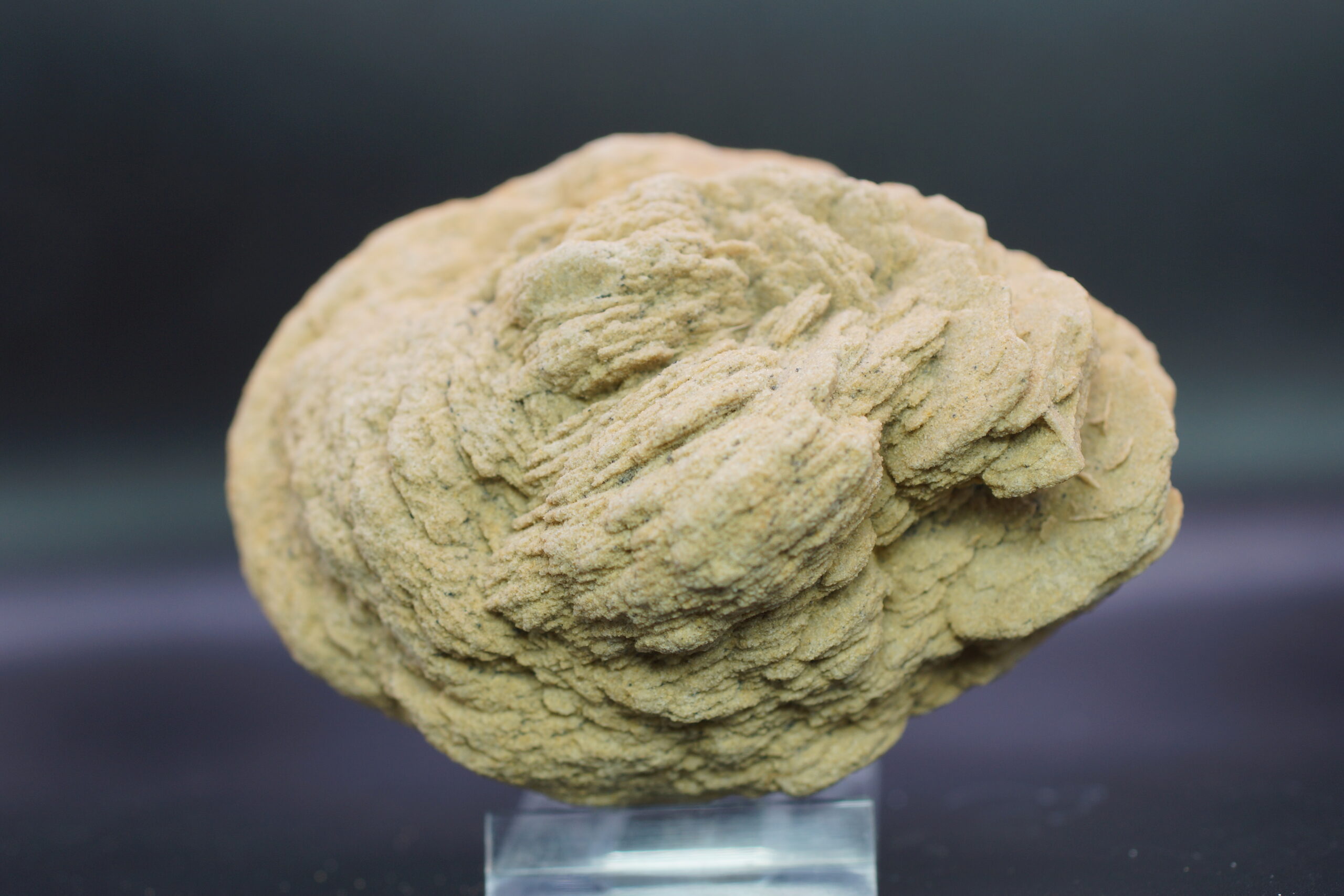
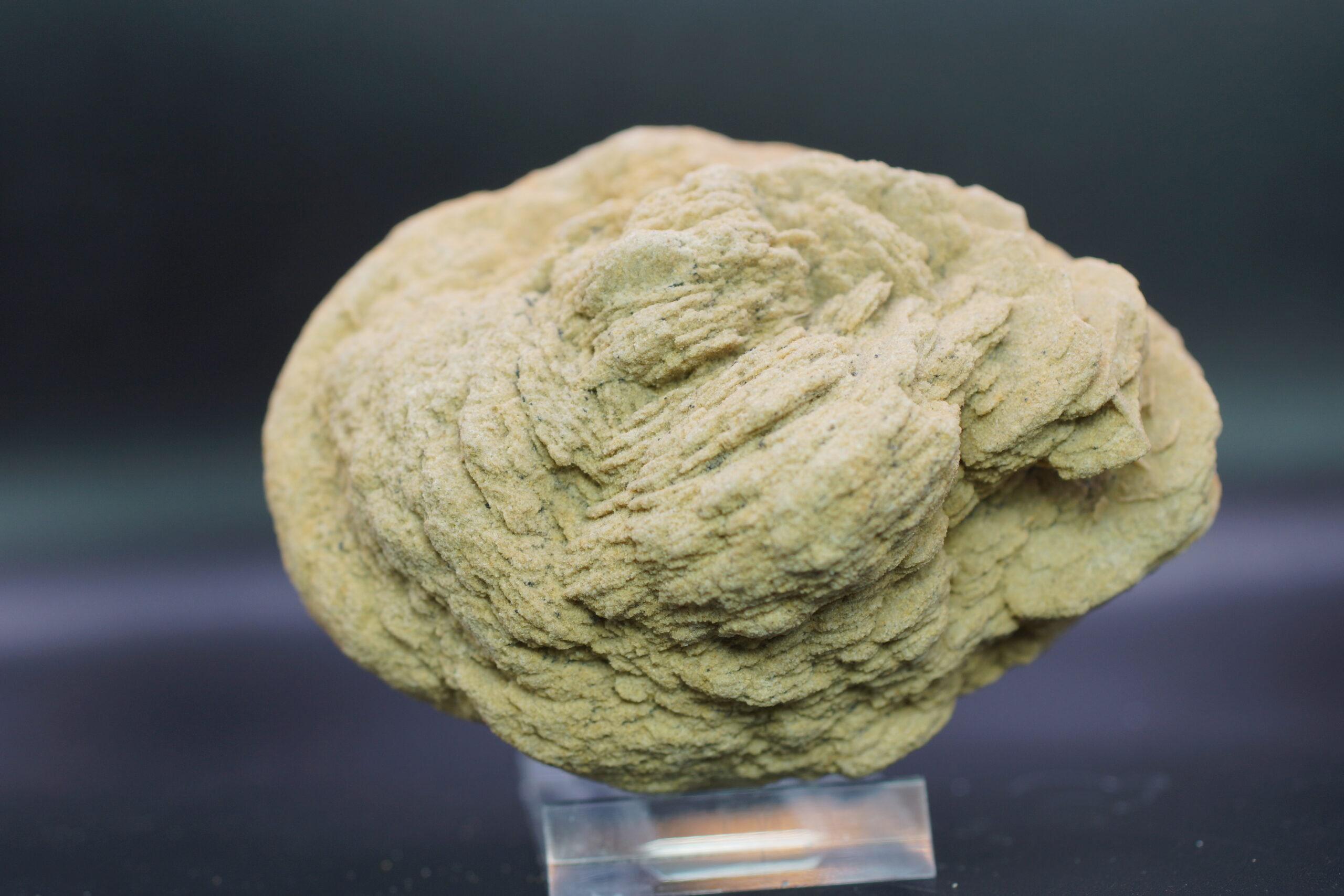


This barite rose comes from the sand pits near Rockenberg in the Wetterau district of Hesse, Germany. The specimen shows a compact, rosette-shaped formation composed of brown barite with included quartz sand grains.
Individual tabular crystal sections are intergrown to form irregular rosettes and nodular aggregates. Their earthy brown color and matte to slightly lustrous surface are characteristic of the barite roses from Rockenberg. With a length of 10.5 cm, the piece belongs to the large cabinet specimen size category.
Barite Rose from the Classic Rockenberg Locality
Rockenberg is regarded as the most important and, according to the municipality, the only known European locality for well-developed barite roses. The occurrences were restricted to a narrow sandy layer, and several former collecting sites have since been backfilled or reclaimed.
The barite roses formed through the slow crystallization of barium sulfate from mineral-bearing pore waters within sandy sediments. During crystal growth, the barite incorporated numerous quartz sand grains. This process produced the characteristic rosette-shaped aggregates. Their formation is assigned to the Miocene.
The combination of unusual crystal form, regional geological significance, and classic German provenance makes this piece a characteristic locality specimen from the Wetterau region.
| Feature | Details |
|---|---|
| Mineral | Barite |
| Form | Barite rose or sand rose |
| Chemical Composition | Barium sulfate, BaSO₄ |
| Locality | Sand pits near Rockenberg, Wetterau district, Hesse, Germany |
| Dimensions | 10.5 × 7.5 × 7.0 cm |
| Weight | 569 g |
| Specimen Size | Large cabinet specimen |
| Color | Brown to earthy brown |
| Luster | Matte to earthy |
| Crystal form | Rosette-shaped and nodular crystal aggregates |
| Inclusions | Quartz sand |
| Formation | Crystallization within sandy sediments |
| Special Feature | Barite rose from the classic Rockenberg locality |
| Mineral | Barite |
|---|---|
| Color | Brown |
| Size | Large cabinet (>10 cm) |
| Continent | Europe |
| Country | Germany |
| Feature | Classic locality |
Be the first to review “Barite Rose from Rockenberg, Hesse, Germany”
Related products
No VAT is shown in accordance with Section 19 (1) of the German VAT Act. Shipping costs apply.
plus shipping costs
No VAT is shown in accordance with Section 19 (1) of the German VAT Act. Shipping costs apply.
plus shipping costs
No VAT is shown in accordance with Section 19 (1) of the German VAT Act. Shipping costs apply.
plus shipping costs


No VAT is shown in accordance with Section 19 (1) of the German VAT Act. Shipping costs apply.
plus shipping costs
No VAT is shown in accordance with Section 19 (1) of the German VAT Act. Shipping costs apply.
plus shipping costs

No VAT is shown in accordance with Section 19 (1) of the German VAT Act. Shipping costs apply.
plus shipping costs
No VAT is shown in accordance with Section 19 (1) of the German VAT Act. Shipping costs apply.
plus shipping costs

No VAT is shown in accordance with Section 19 (1) of the German VAT Act. Shipping costs apply.
plus shipping costs
Reviews
There are no reviews yet.