

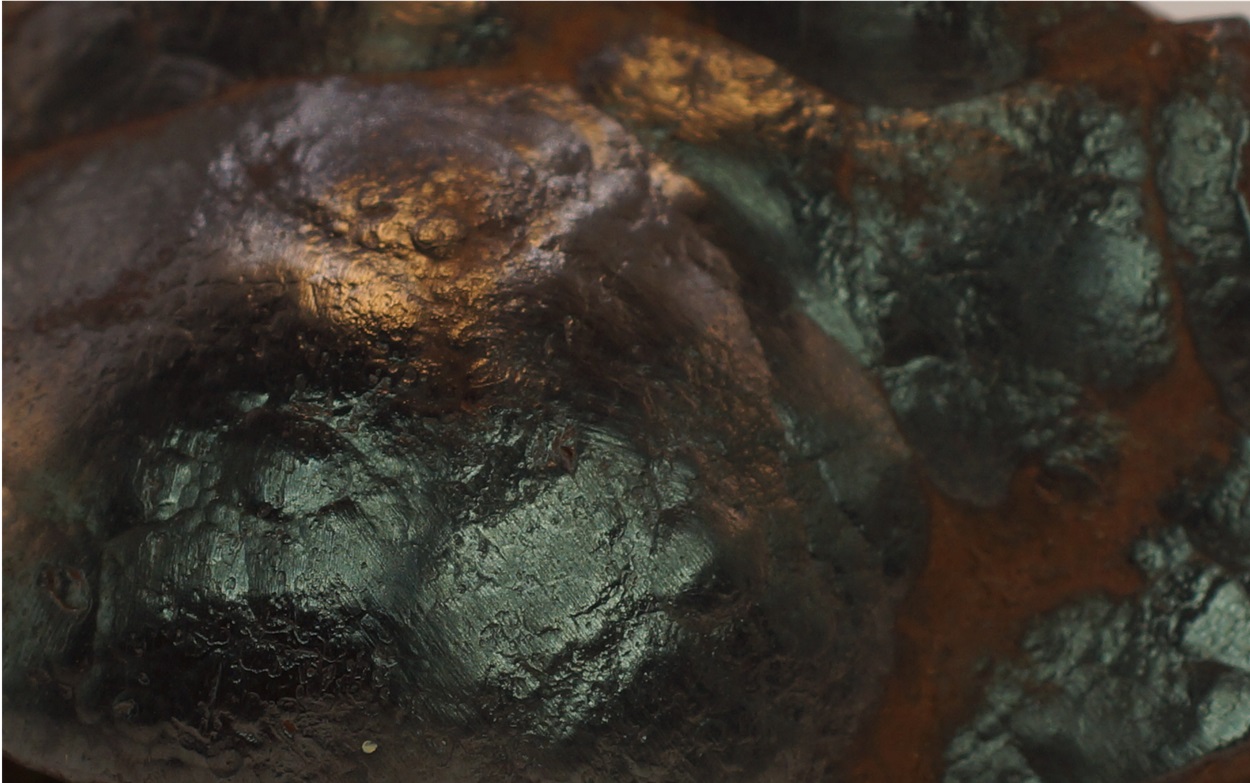
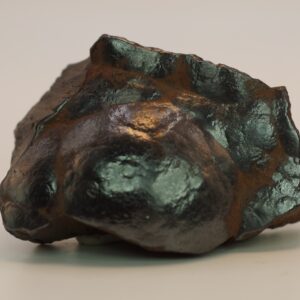
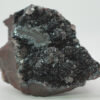
This hematite specimen comes from the historic iron mining district of Egremont in Cumbria, England. The hematite forms a compact surface with rounded to botryoidal structures and a steel-gray to black color.
Numerous small, colorless quartz crystals sit on the hematite. They show a rhombohedrally dominated habit characteristic of classic quartz specimens from the former county of Cumberland. Under direct light, the metallic hematite contrasts clearly with the vitreous quartz crystals.
Measuring 5.2 × 4.0 × 2.0 cm, the piece belongs to the small cabinet specimen size category. It weighs 93 g.
Hematite and Quartz from the West Cumberland Iron Field
The area around Egremont was one of the most important iron ore mining districts in West Cumbria. Hematite occurred there in massive, botryoidal, and crystallized forms. Quartz is one of the characteristic associated minerals and locally forms the rhombohedrally dominated crystals known as the Cumberland habit.
The combination of botryoidal hematite, small quartz crystals, and the classic British locality makes this a characteristic specimen from the Egremont mining district.
| Feature | Details |
|---|---|
| Mineral | Hematite |
| Chemical composition | Iron(III) oxide, Fe₂O₃ |
| Traditional german name | Roter Glaskopf |
| Locality | Egremont, West Cumberland Iron Field, Cumbria, England |
| Dimensions | 5.2 x 4.0 x 2.0 cm |
| Weight | 93 g |
| Specimen Size | Small Cabinet Specimen |
| Color | Dark brown to black |
| Luster | Metallic |
| Aggregate form | Rounded to botryoidal |
| Surface | Compact, distinctly structured hematite aggregates |
| Special Feature | Botryoidal hematite from the classic Egremont locality |
| Mineral | Hematite |
|---|---|
| Color | Brown |
| Size | Small cabinet specimen (5-7 cm) |
| Continent | Europe |
| Country | England |
| Feature | Classic locality |
Be the first to review “Botryoidal Hematite with Quartz from Egremont, England”
Related products

No VAT is shown in accordance with Section 19 (1) of the German VAT Act. Shipping costs apply.
plus shipping costs

No VAT is shown in accordance with Section 19 (1) of the German VAT Act. Shipping costs apply.
plus shipping costs


No VAT is shown in accordance with Section 19 (1) of the German VAT Act. Shipping costs apply.
plus shipping costs
No VAT is shown in accordance with Section 19 (1) of the German VAT Act. Shipping costs apply.
plus shipping costs
No VAT is shown in accordance with Section 19 (1) of the German VAT Act. Shipping costs apply.
plus shipping costs
No VAT is shown in accordance with Section 19 (1) of the German VAT Act. Shipping costs apply.
plus shipping costs
No VAT is shown in accordance with Section 19 (1) of the German VAT Act. Shipping costs apply.
plus shipping costs

No VAT is shown in accordance with Section 19 (1) of the German VAT Act. Shipping costs apply.
plus shipping costs
Reviews
There are no reviews yet.