

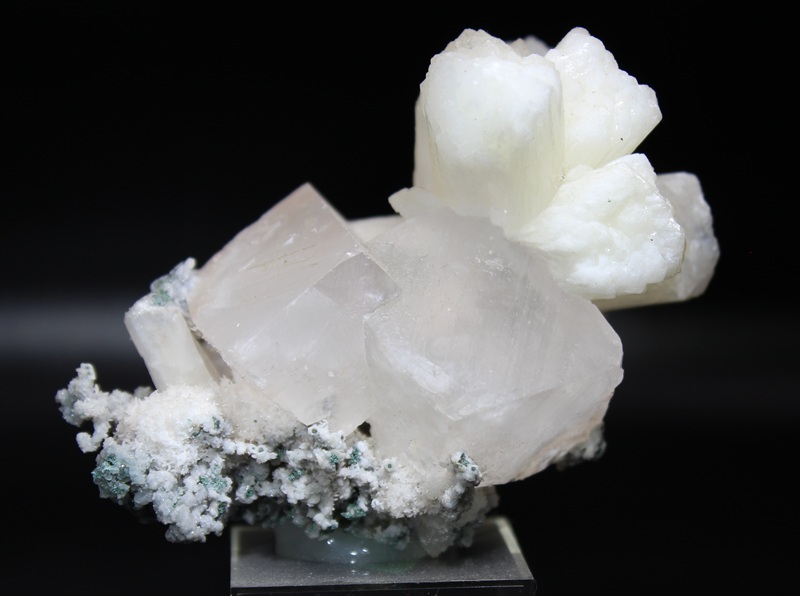
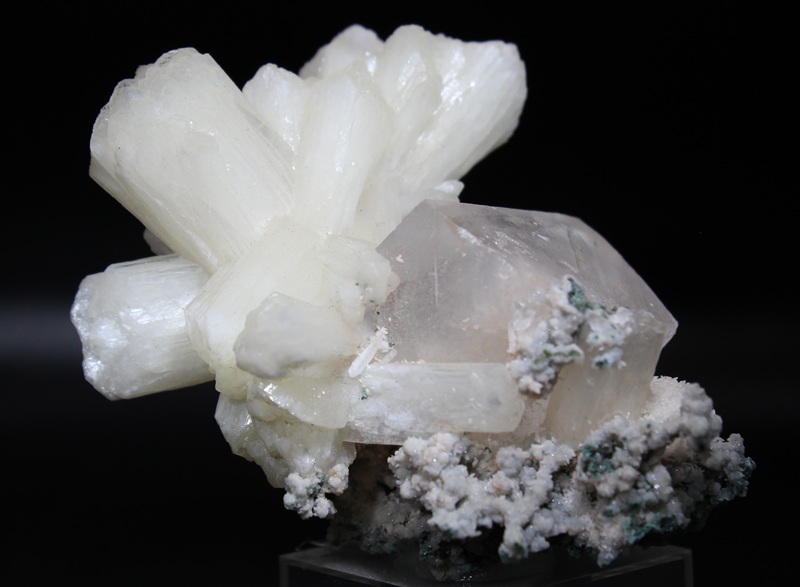
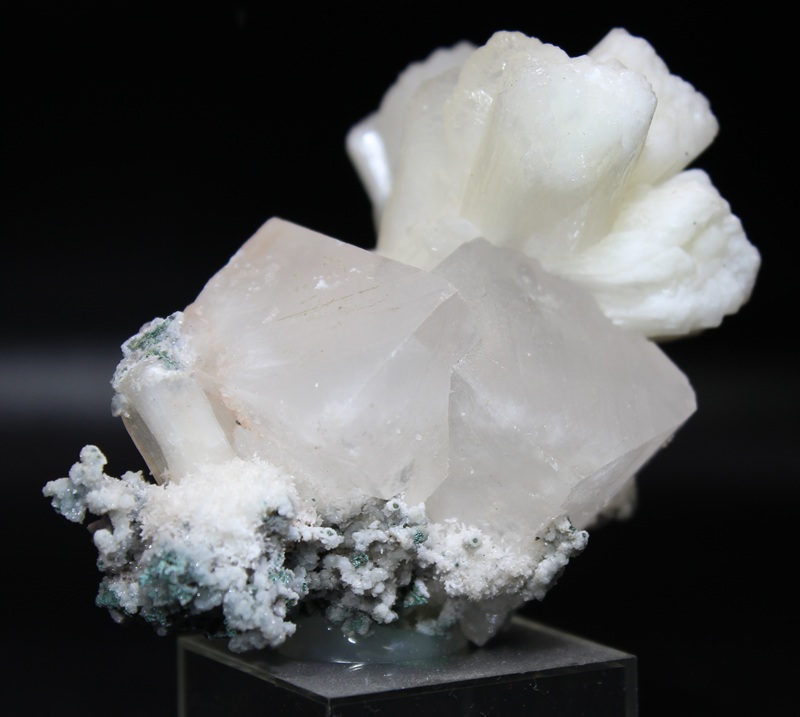
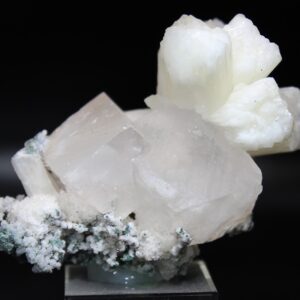
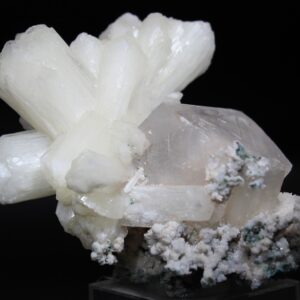
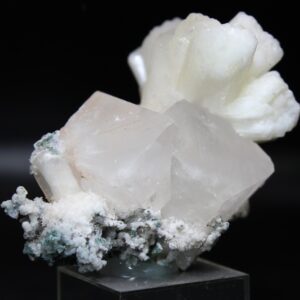
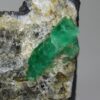
This mineral specimen comes from the Jalgaon district in the Indian state of Maharashtra. Pale stilbite crystals occur together with calcite on a crystallized matrix.
The stilbite forms bladed to tufted aggregates with a white to cream-colored appearance. The crystal surfaces show a pearly to silky luster. Pale calcite crystals occur between the stilbite aggregates and complement the three-dimensional mineral association. With a length of 5.5 cm, the piece belongs to the small cabinet specimen size category.
Stilbite and Calcite from the Deccan Traps
The Jalgaon district is one of India’s well-known source regions for zeolites and other secondary minerals. The area lies within the Deccan Traps, whose extensive basaltic lava sequences contain numerous former gas bubbles and cavities.
After the basalts had solidified, mineral-bearing fluids circulated through fractures and cavities. This process formed minerals including stilbite, calcite, apophyllite, heulandite, scolecite, and quartz. Stilbite and calcite may occur together within the same cavities.
The combination of bladed stilbite, pale calcite, and documented provenance makes this piece a characteristic mineral specimen from the Deccan Traps of Maharashtra.
| Feature | Details |
|---|---|
| Minerals | Stilbite and Calcite |
| Locality | Jalgaon district, Nashik Division, Maharashtra, India |
| Dimensions | 5.5 × 4.5 × 4.0 cm |
| Weight | 71.5 g |
| Specimen Size | Small Cabinet Specimen |
| Color | White to cream-colored |
| Luster | Pearly to silky |
| Crystal Habit | Bladed to tufted stilbite aggregates with calcite |
| Host Rock | Basaltic matrix |
| Formation | Secondary mineral formation in cavities of basaltic lava flows |
| Special Feature | Stilbite-calcite association from the Deccan Traps |
| Mineral | Calcite, Stilbite |
|---|---|
| Color | Colorless, White |
| Size | Small cabinet specimen (5-7 cm) |
| Continent | Asia |
| Country | India |
Be the first to review “Stilbite with Calcite from Jalgaon, Maharashtra, India”
Related products
9. Silicates & Germanates
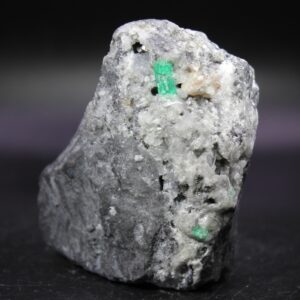
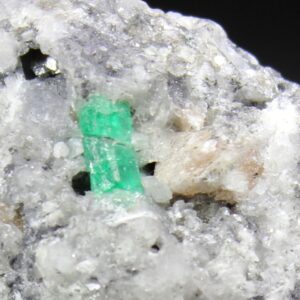
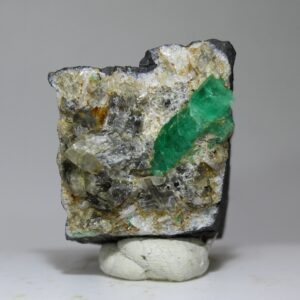
Emerald from Coscuez, Colombia – Translucent Crystal on Matrix
No VAT is shown in accordance with Section 19 (1) of the German VAT Act. Shipping costs apply.
plus shipping costs
9. Silicates & Germanates
No VAT is shown in accordance with Section 19 (1) of the German VAT Act. Shipping costs apply.
plus shipping costs
No VAT is shown in accordance with Section 19 (1) of the German VAT Act. Shipping costs apply.
plus shipping costs
9. Silicates & Germanates
Translucent Emerald on Calcite Matrix from Los Topos, Chivor, Colombia
No VAT is shown in accordance with Section 19 (1) of the German VAT Act. Shipping costs apply.
plus shipping costs
4. Oxides & Hydroxides
No VAT is shown in accordance with Section 19 (1) of the German VAT Act. Shipping costs apply.
plus shipping costs
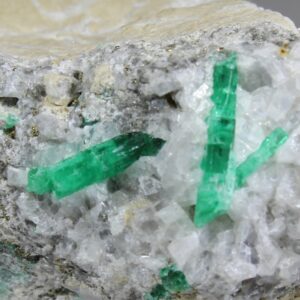
9. Silicates & Germanates
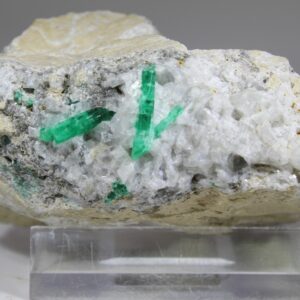
Three Emerald Crystals on Calcite Matrix from Chivor, Boyacá, Colombia
No VAT is shown in accordance with Section 19 (1) of the German VAT Act. Shipping costs apply.
plus shipping costs
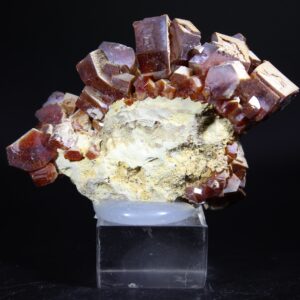
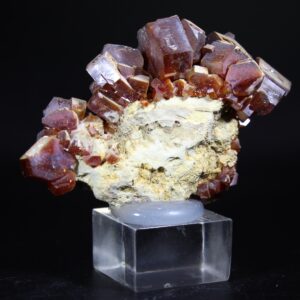
8. Phosphates, Arsenates & Vanadates
Vanadinite from Mibladen, Morocco – Red Crystals with Two-Tone Coloration
No VAT is shown in accordance with Section 19 (1) of the German VAT Act. Shipping costs apply.
plus shipping costs
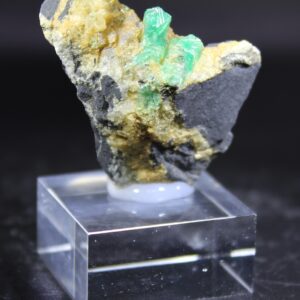
9. Silicates & Germanates
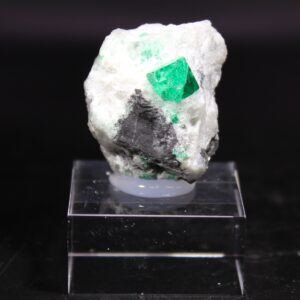
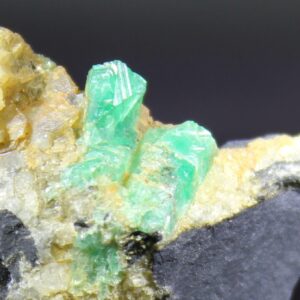
Emerald on Matrix from the La Emilia Concession, Gachalá, Colombia
No VAT is shown in accordance with Section 19 (1) of the German VAT Act. Shipping costs apply.
plus shipping costs
Reviews
There are no reviews yet.