

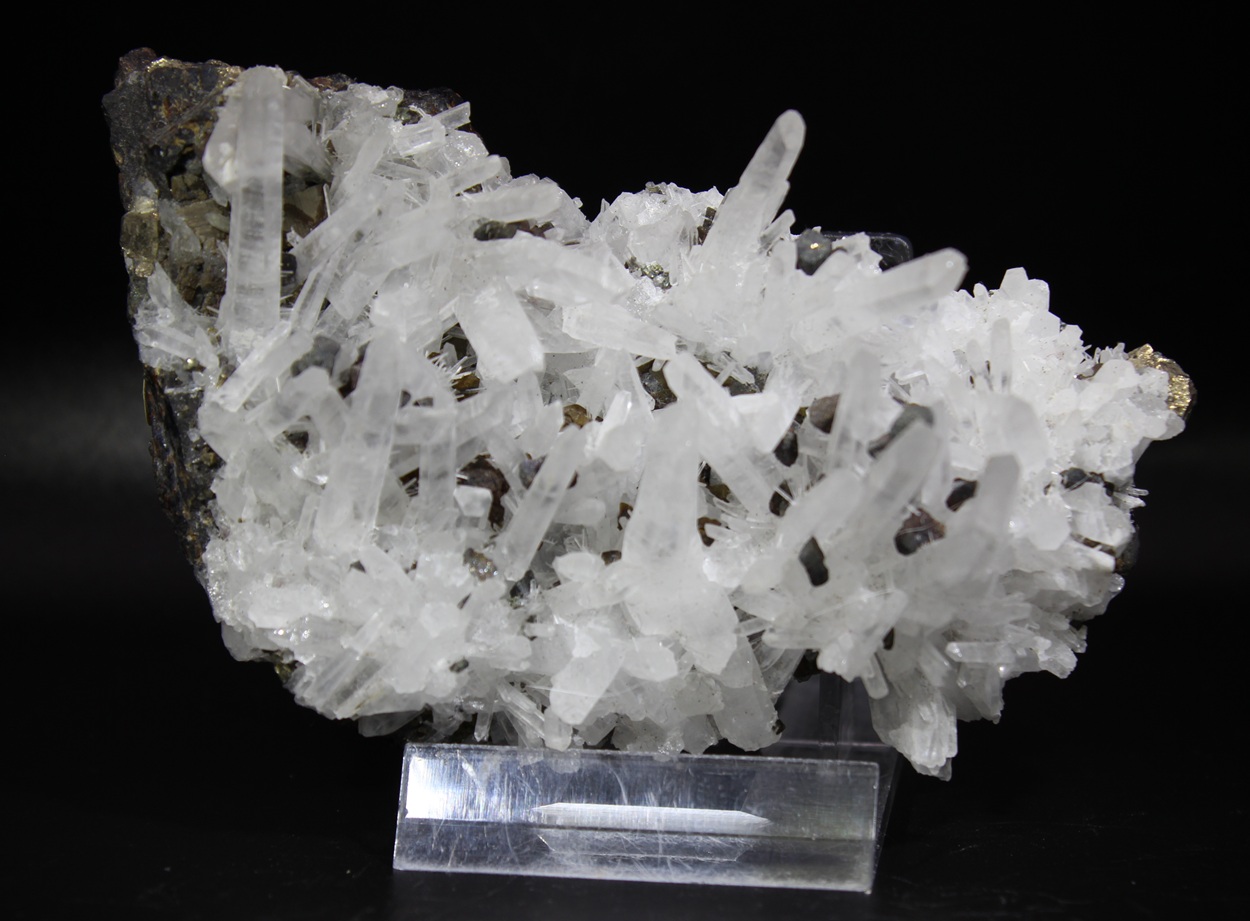
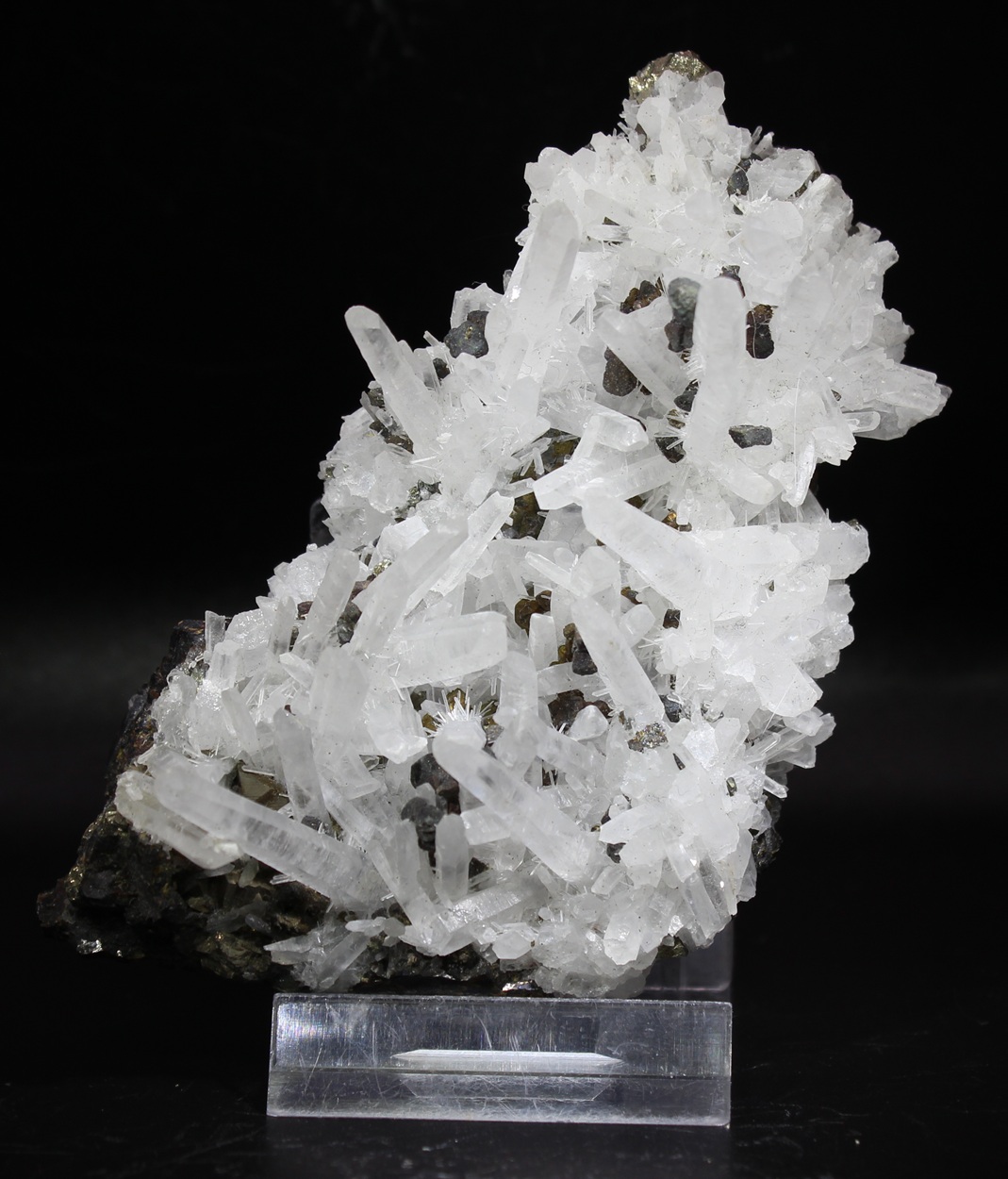
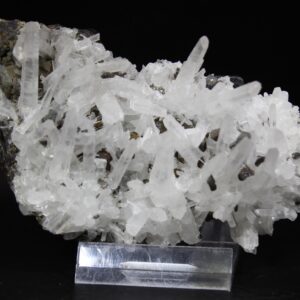
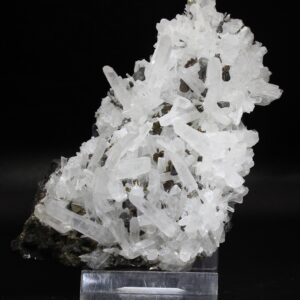
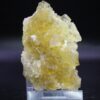
This mineral specimen comes from the historic Huarón mining district in the Pasco region of Peru. Numerous white to colorless quartz crystals cover a dark, sulfide-rich matrix. Small chalcopyrite crystals occur between the quartz crystals, creating a distinct contrast with the pale crystal group through their metallic luster.
The quartz crystals are intergrown in a three-dimensional arrangement and oriented in different directions. This creates an open, lively crystal group that can be displayed both vertically and in a broader side view.
Measuring 9.0 × 6.3 × 3.0 cm and weighing 172.5 g, the specimen belongs to the cabinet specimen size category.
Dense Group of Prismatic Quartz Crystals
The quartz forms numerous long prismatic crystals with clearly developed terminations. Several larger crystals stand out among the many smaller ones and define the three-dimensional structure of the specimen..
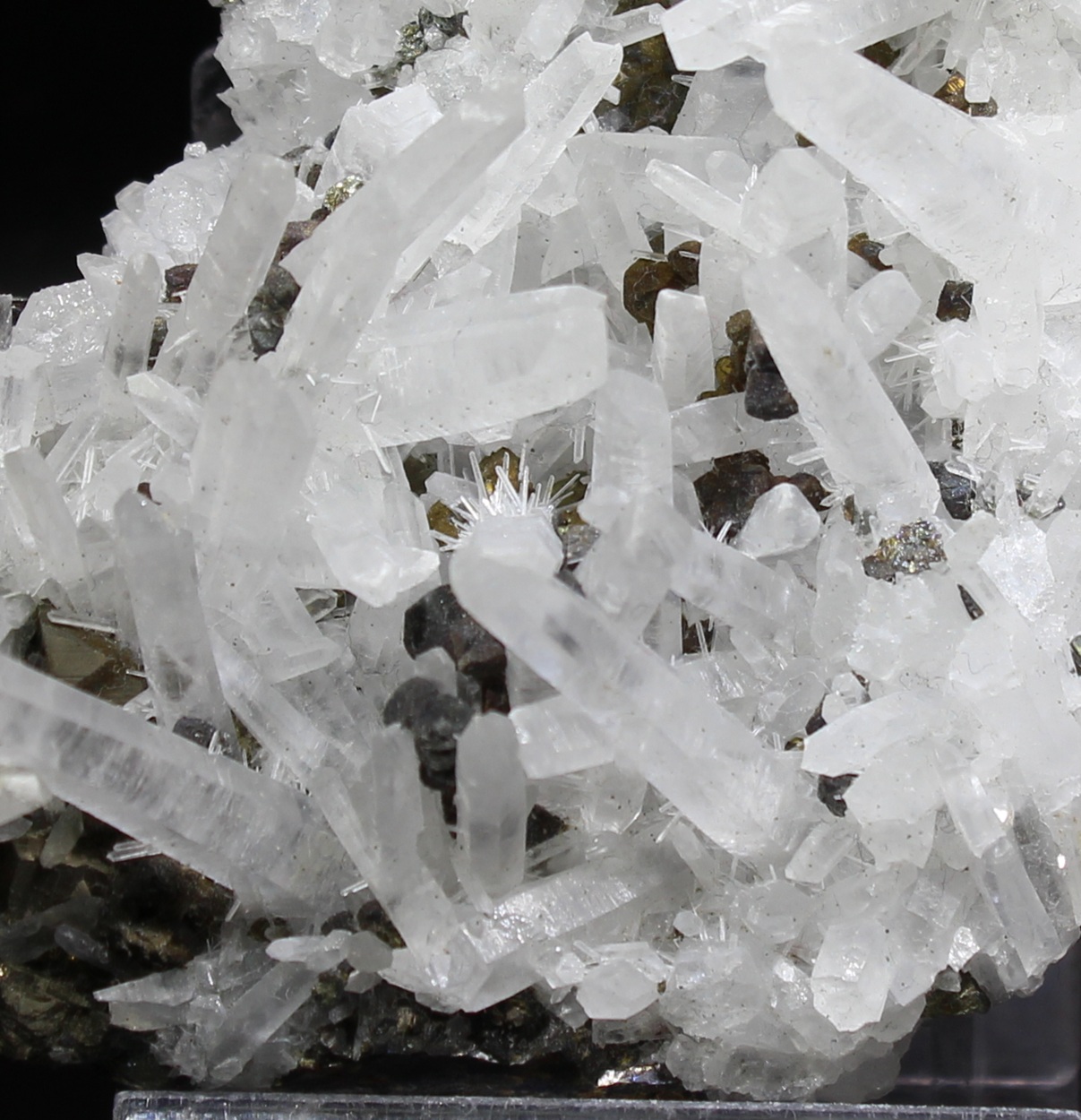
The crystals are predominantly white to colorless and translucent. Individual thinner crystals and marginal areas appear partially transparent. Fine growth structures are locally visible on the crystal faces.
The varying orientation of the quartz crystals creates a diverse overall form. Some crystals project steeply from the matrix, while others extend more horizontally or grow diagonally across neighboring crystals.
Chalcopyrite as a Contrasting Associated Mineral
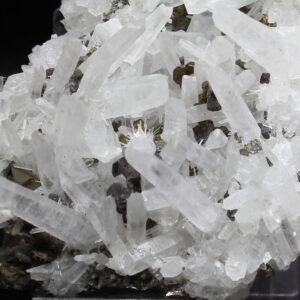
Numerous small chalcopyrite crystals and sulfide sections occur between the quartz crystals. They appear dark brass-colored to locally brownish due to surface tarnishing and stand out clearly against the white quartz.
The chalcopyrite does not form a single dominant crystal but is distributed across large areas of the specimen. The detailed view shows particularly well how the metallic sections occur between and partly on the quartz crystals.
The association of pale quartz and metallic chalcopyrite is characteristic of many hydrothermal ore assemblages in the Peruvian Andes.
Mineral Specimen from a Classic Peruvian Mining District
The Huarón district is one of Peru’s important polymetallic mining regions. Its hydrothermal vein systems produced numerous sulfides and associated minerals, including quartz and chalcopyrite.
This specimen displays the association as a broadly crystallized cabinet specimen. Quartz forms the dominant visual component, while the scattered chalcopyrite crystals document the specimen’s ore-deposit context.
The piece therefore combines an attractive crystal group with a classic provenance from Peru’s mining industry.
| Feature | Details |
|---|---|
| Main mineral | Quartz |
| Variety | Rock crystal |
| Chemical composition | SiO₂ |
| Associated Mineral | Chalcopyrite |
| Chemical composition of chalcopyrite | CuFeS₂ |
| Locality | Huarón mining district, Huayllay, Pasco Province, Pasco Region, Peru |
| Dimensions | 9.0 × 6.3 × 3.0 cm |
| Weight | 172.5 g |
| Specimen Size | Cabinet specimen |
| Color of Quartz | White to colorless |
| Color of Chalcopyrite | Brass-colored to dark brownish |
| Transparency | Quartz predominantly translucent, partially transparent in individual crystals and along some edges |
| Crystal habit of Quartz | Long prismatic crystals with developed terminations |
| Crystal habit of Chalcopyrite | Small metallic crystals and crystal sections |
| Crystal arrangement | Numerous differently oriented quartz crystals with scattered chalcopyrite |
| Matrix | Dark sulfide-rich matrix |
| Special Feature | Three-dimensional quartz group with contrasting chalcopyrite from a classic Peruvian mining district |
| Mineral | Chalcopyrite, Quartz, Rock crystal |
|---|---|
| Color | Black, Colorless, Yellow |
| Size | Cabinet specimen (7-10 cm) |
| Continent | South America |
| Country | Peru |
Be the first to review “Rock Crystal with Chalcopyrite from the Huarón Mining District, Peru”
Related products

No VAT is shown in accordance with Section 19 (1) of the German VAT Act. Shipping costs apply.
plus shipping costs
No VAT is shown in accordance with Section 19 (1) of the German VAT Act. Shipping costs apply.
plus shipping costs
No VAT is shown in accordance with Section 19 (1) of the German VAT Act. Shipping costs apply.
plus shipping costs
No VAT is shown in accordance with Section 19 (1) of the German VAT Act. Shipping costs apply.
plus shipping costs
No VAT is shown in accordance with Section 19 (1) of the German VAT Act. Shipping costs apply.
plus shipping costs
No VAT is shown in accordance with Section 19 (1) of the German VAT Act. Shipping costs apply.
plus shipping costs
No VAT is shown in accordance with Section 19 (1) of the German VAT Act. Shipping costs apply.
plus shipping costs
No VAT is shown in accordance with Section 19 (1) of the German VAT Act. Shipping costs apply.
plus shipping costs
Reviews
There are no reviews yet.