

Localities
Pyrite from Ambas Aguas (Ambasaguas), La Rioja – Locality, Geology and Crystal Forms
Nov
Pyrite from Ambas Aguas is one of the classic collector minerals from Spain. The locality is particularly well known for its wide variety of cubes, pyritohedra and combinations of both forms. This article provides an overview of the locality, its geology, the individual collecting areas, typical crystal forms and the features that characterize high-quality specimens.
Ambas Aguas – a classic pyrite locality in La Rioja
The pyrites from Ambas Aguas, also commonly written as Ambasaguas, are known among mineral collectors worldwide for their exceptional variety of crystal forms and combinations. In addition to cubic crystals, pyritohedra, or pentagonal dodecahedra, are particularly characteristic, together with numerous combinations of different forms. It is precisely this morphological diversity that distinguishes Ambas Aguas from many other classic pyrite localities [1][4].
The locality is situated near the small village of Ambas Aguas in La Rioja, northern Spain. The pyrite deposits have been worked specifically for collector specimens for decades. The locality is operated by Manuel Urruchi Barrón from Pamplona. Mineral collectors can also visit the site by prior arrangement and search for pyrite themselves for a daily fee [5]. This was also possible during my own visit.
Location and collecting area
Ambas Aguas, also known as Ambasaguas or Entrambas Aguas, is a small settlement belonging to the municipality of Muro de Aguas in the autonomous community of La Rioja in northern Spain. The village lies at an elevation of around 870 metres, approximately 6.6 kilometres from Muro de Aguas. Today, only a small number of people live there. The surrounding landscape is characterised by the mountain ranges and deeply incised valleys of southern La Rioja [6].
The pyrite occurrences collectively known among collectors as the “Ambas Aguas locality” are not restricted to a single outcrop. Several collecting areas occur around the village along small streams and ravines where the pyrite-bearing sedimentary rocks are exposed. Among the most important are the western and eastern Vallaroso streams, La Urruñada or Laorrañuda, and Las Cañadillas in the Barranco de Aguasala [1][4]. The Spanish Geological Survey, IGME, also lists Laorrañuda and the Arroyo de las Cañadillas among the classic pyrite occurrences of Ambasaguas [3].
Some of these outcrops have been worked by small-scale excavations. The pyrite is not mined as an industrial raw material but primarily for collector and decorative specimens. Some of the occurrences have been known for more than a century [1]. The individual collecting areas can differ considerably in terms of matrix and crystal habit, an aspect discussed in more detail below.
Regionally, Ambas Aguas forms part of a wider group of important pyrite localities in the border area between La Rioja and the province of Soria. Further minerals from Spain can be found in the corresponding category of Mineralien weltweit. One of the best-known nearby localities is Navajún, around 15 kilometres away, with the Ampliación a Victoria Mine. While Navajún is particularly famous for its exceptionally regular cubic pyrite crystals, Ambas Aguas is characterised by a much greater variety of crystal forms and combinations [1][3][4].
Geological setting and formation of the pyrite mineralisation
The pyrite occurrences of Ambas Aguas are located within the Cameros Basin, a Mesozoic sedimentary basin of the Iberian Range. The pyrite-bearing rocks belong predominantly to the Urbión Group and are assigned to the so-called Weald facies. They consist mainly of sandstones and marly sediments of Early Cretaceous age, ranging from the Berriasian to the Aptian. The pyrite crystals occur particularly within marl-rich layers [3].
The formation of the exceptionally well-developed pyrite crystals is now linked to hydrothermal metamorphism during burial of the sediments. Fluids circulated through the sedimentary succession and mobilised sulphur, while the iron required for pyrite formation was derived predominantly from the sediments themselves. Under reducing conditions, pyrite could form, or pre-existing finely disseminated pyrite could recrystallise and grow into the crystals visible today, some of which reach several centimetres in size [3].
The pyrites are predominantly embedded directly within the marl and may occur either as individual crystals or as crystal groups. Locally, the host rocks were subsequently altered and partly recrystallised. This process produced, among other features, calcite veins and small cavities. Pyrite crystals from such areas may display fractures that were later filled with calcite. This phenomenon has been described, among other places, from the Arroyo Vallaroso area near Ambas Aguas [1].
Near the Earth’s surface, the pyrites are also affected by weathering. This can lead to the formation of iron oxides and iron hydroxides, which may cover the crystals with brown to rust-coloured coatings. Secondary iron sulphates also occur at some of the localities. The state of preservation of the crystals therefore depends not only on their original development, but also on the extent to which the respective layers were later exposed to weathering [1].
Crystal forms of the pyrites from Ambas Aguas
The pyrite occurrences of Ambas Aguas are distributed across several mining areas and outcrops. The areas that are currently accessible to collectors are also referred to individually. At present, the official website specifically lists the Elena and Patricia collecting areas [5]. The pyrites occurring there can differ considerably in terms of crystal habit, intergrowth and matrix.
During my own visit, I collected in the Elena area. There I found mainly cubic pyrites, distinctly pyritohedral crystals, and numerous transitional forms between cube and pyritohedron. A particularly illustrative crystal-form series from Ambasaguas clearly shows the transition between pyritohedron and cube. I did not observe any octahedral forms there.

In the Patricia area, by contrast, densely intergrown, pine-cone-shaped aggregates were particularly common. These so-called “Piñas” or “pine-cone” aggregates consist of numerous small, intergrown pyrite crystals and illustrate how strongly the appearance of the pyrites can vary even within the same locality.
Cube
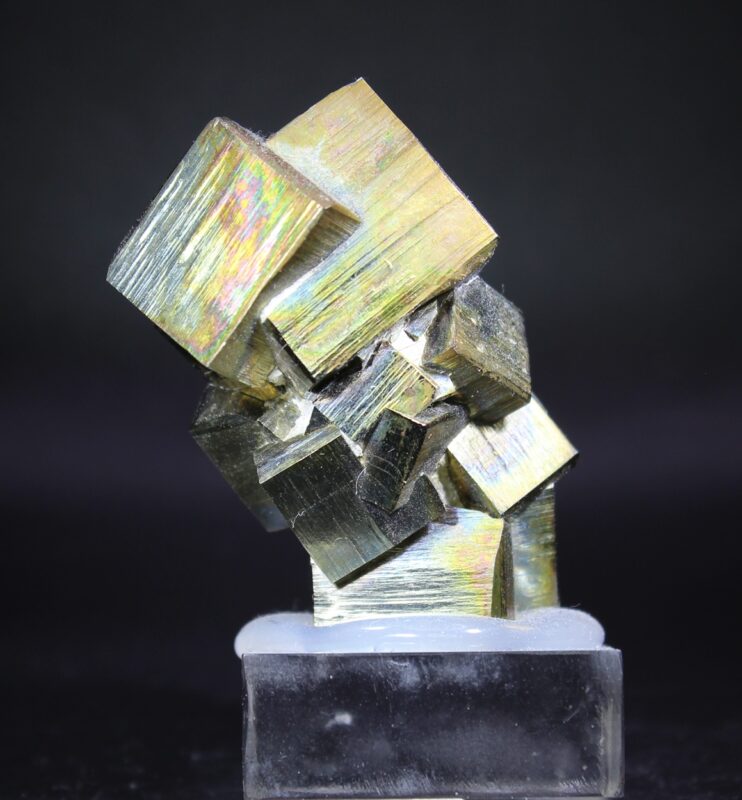
{100}One of the most common forms is the cube {100}. The crystals can be very regularly developed, but they often show pronounced striations on their faces. Distorted cubes and crystals with faces developed to varying degrees also occur [1][4]. A predominantly cubic pyrite specimen from Ambasaguas illustrates this typical crystal habit particularly well.
Pyritohedron
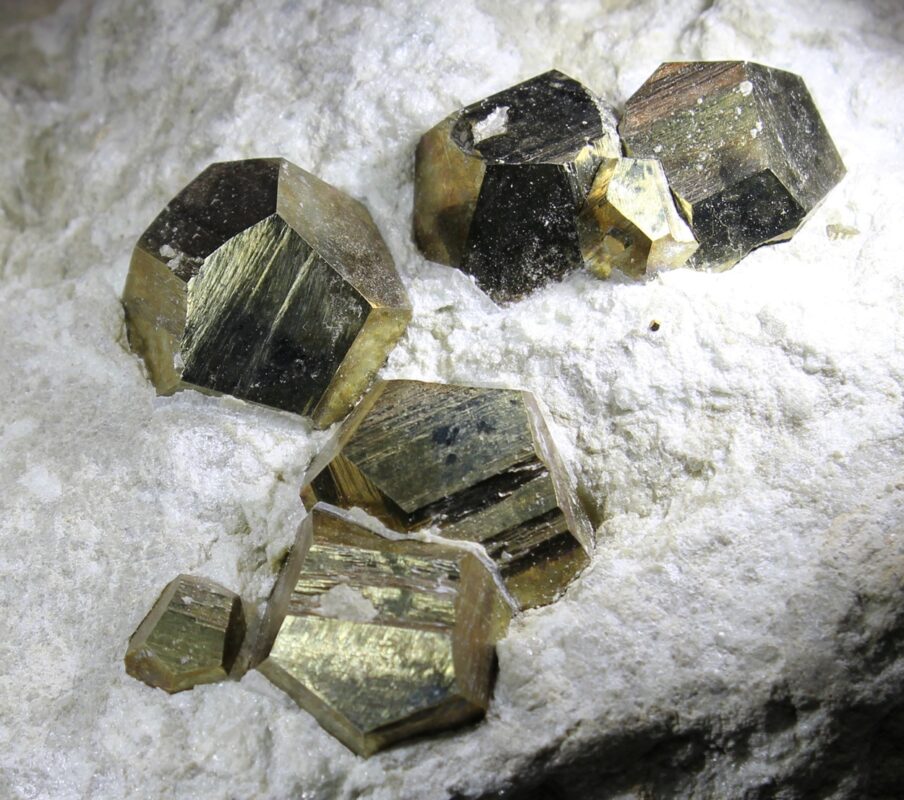
The pyritohedron {210} is another characteristic crystal form. It is a pentagonal dodecahedron composed of twelve pentagonal faces. Fully developed pyritohedra occur alongside crystals in which this form is only partially developed [1][4].
Combinations of cube and pyritohedron
Particularly interesting are the numerous combinations of both forms. Individual crystals may display both cube faces {100} and pyritohedron faces {210}. Depending on the relative development of these faces, the crystal may appear predominantly cubic or distinctly pyritohedral [1][4].
These transitional forms were among the most common specimens I found during my own visit. A pyrite specimen from Ambasaguas with clearly developed cube and pyritohedron faces illustrates this combination particularly well.
Intergrowths and aggregates
In addition to individual crystals, intergrowths and groups consisting of several pyrite crystals also occur. Depending on the collecting area, different aggregate types and crystal habits may dominate. Among the forms known from Ambas Aguas are more complex intergrowths as well as the characteristic “Piñas” or pine-cone-like aggregates [4].
Because the individual sub-localities can differ in both mineralisation and the appearance of the pyrites, it is worth taking a closer look at the separate collecting areas.
Differences between the individual collecting areas
The pyrite occurrences of Ambas Aguas are distributed across several collecting areas, some of which differ considerably in terms of crystal development and matrix. As early as 1989, Calvo and Sevillano described three major occurrences in the immediate vicinity of the village: Arroyo de las Cañadillas, Arroyo de la Urruñada and Arroyo Vallaroso [1].
Arroyo de las Cañadillas
At Arroyo de las Cañadillas, the pyrites occur in a dark grey to black marl matrix. Typical forms include simple pyritohedra ranging in size from a few millimetres to around two centimetres. Larger aggregates, some measuring several centimetres, also occur and consist of intergrown, often strongly distorted pyritohedra [1].
These aggregates may show a radial-fibrous internal structure. Larger specimens in particular can be unstable and may break apart under humid storage conditions. They are frequently associated with secondary iron sulphates. Specimens found close to the surface may also show pronounced weathering [1].
Arroyo de la Urruñada
Arroyo de la Urruñada is regarded as the classic locality for specimens known as “Ambasaguas pyrites”. Several small adits were formerly driven here for the recovery of collector specimens [1].
The pyrites occur individually or in groups within a light-coloured to white marl matrix. Cubes with distinct pyritohedral modifications are particularly characteristic. The cube faces can be strongly striated. According to Calvo and Sevillano, the crystals can reach around three centimetres in size, although they are more commonly in the range of one to one and a half centimetres [1].
Many crystals have a thin surface coating of iron oxides. Beneath this coating, however, a strong metallic lustre may still be preserved [1].
Arroyo Vallaroso
Arroyo Vallaroso lies west to northwest of Ambas Aguas and, at the time of Calvo and Sevillano’s publication, was one of the most intensively collected areas in the vicinity [1].
Here, lustrous brass-yellow pyritohedra and combinations of cube and pyritohedron occur in a grey marl matrix. The crystals may occur individually or in groups and can reach sizes of around three centimetres. Some are distinctly distorted. Because of the large number of crystals, highly attractive matrix specimens with numerous freely grown pyrites can form [1].
Pyrites with later-formed fractures subsequently filled with calcite are also known from the Vallaroso area. They show that the crystals were subjected to mechanical stress after their growth and were later penetrated by mineral-bearing fluids [1].
These differences show that “pyrite from Ambas Aguas” should not be regarded as a single, uniform locality type. Depending on the outcrop, the matrix, crystal habit, intergrowths and state of preservation can vary considerably. This diversity is an important part of what makes the locality so distinctive.
Matrix and associated minerals
The pyrites from Ambas Aguas occur predominantly in marly to shaly sedimentary rocks. Depending on the collecting area, the matrix can differ considerably. In the La Urruñada and Vallaroso areas, it is usually light to medium grey, whereas specimens from Arroyo de las Cañadillas often have a distinctly darker, almost black matrix [1]. In some cases, these differences can already provide an indication of a specimen’s origin within the locality.
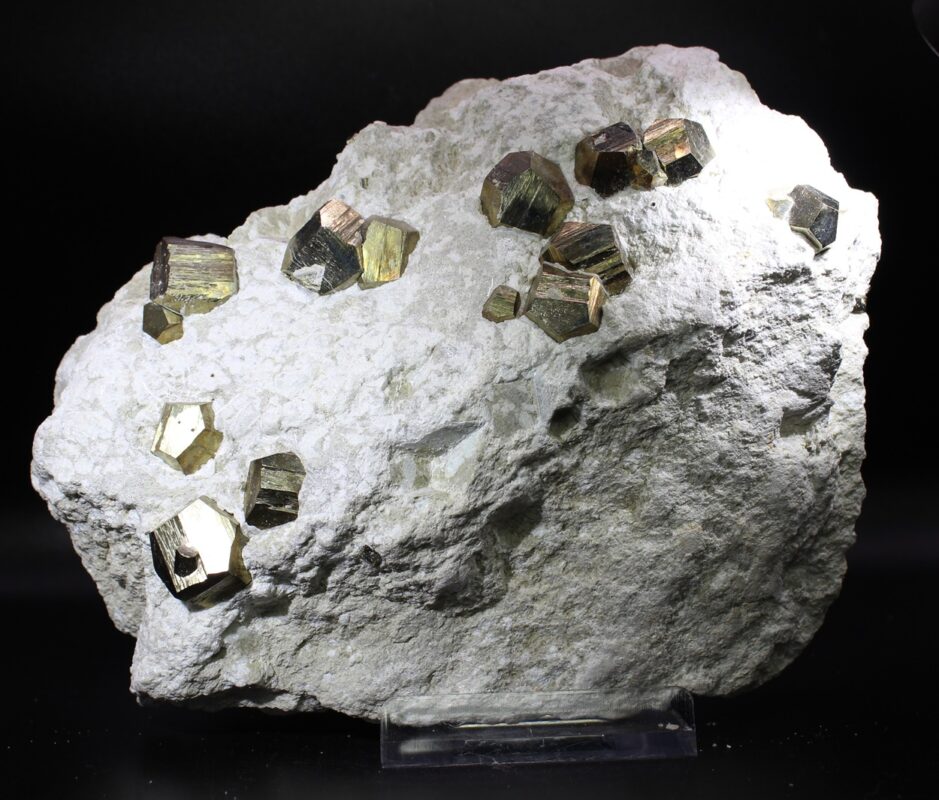
Well-preserved matrix specimens are particularly attractive because the brass-yellow pyrite crystals stand out clearly against the grey to black host rock. At the same time, the matrix is often relatively soft and brittle. During extraction, the crystals can therefore break out of the rock easily, which is why larger specimens with several well-preserved, free-standing crystals are comparatively rare.
In addition to pyrite, quartz, gypsum and limonite are also known from Ambas Aguas [4]. Gypsum can form secondarily when sulphate-rich solutions produced during the oxidation of pyrite react with calcium-bearing components of the host rock. Limonite occurs mainly as a weathering product of pyrite and may coat the crystals or the surrounding matrix with brown to rust-coloured films.
A mineralogical peculiarity of the locality is cookeite, a lithium-bearing mineral of the chlorite group. Cookeite has been documented from Ambas Aguas, although it plays only a very subordinate role compared with the dominant pyrite. Other members of the chlorite group, as well as chloritoid, have also been described [4].
When Spanish pyrite is mentioned, many collectors first think of Navajún. The pyrites from this locality are particularly famous for their exceptionally regular, sharp-edged cubes, which often appear to have grown almost perfectly out of the light-coloured matrix [1][3].
A typical pyrite specimen from Navajún with regularly developed cubes illustrates this characteristic crystal habit particularly well.
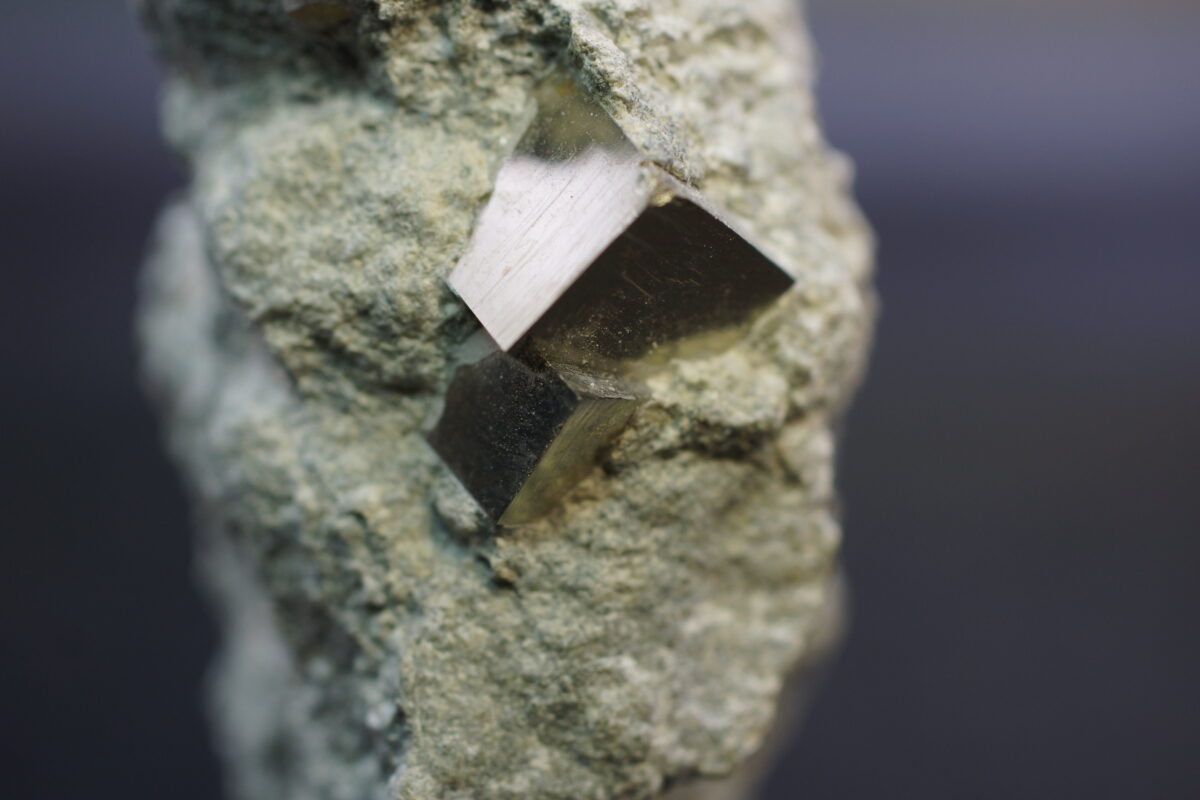
Ambas Aguas, by contrast, has a different appearance. Cubic crystals also occur here, but the morphological diversity is considerably greater. Pyritohedra and numerous combinations of cube and pyritohedron are particularly characteristic. Intergrowths and crystals showing varying degrees of distortion also occur, giving individual specimens a much more distinctive character [1][4].
The matrix also varies more strongly between the individual sub-localities. While Navajún is often characterised by the strong contrast between large, regular cubes and a light-coloured matrix, specimens from Ambas Aguas may occur on both light and darker matrix and can display very different crystal groups [1].
Both localities therefore belong to the classic pyrite occurrences of the region, but they represent different aspects of the same mineral: Navajún is especially known for exceptionally regular cubes, while Ambas Aguas is characterised above all by its diversity of crystal forms and intergrowths.
What makes a good specimen from Ambas Aguas?
The quality of a pyrite specimen from Ambas Aguas cannot be judged solely by the size of its crystals. At this locality in particular, crystal form, preservation, matrix and the overall aesthetics of a specimen all play an important role.
Specimens with sharply developed and, as far as possible, undamaged crystals are especially attractive. Broken edges and heavily damaged crystal faces can significantly reduce the aesthetic appeal. At the same time, slight growth irregularities or intergrowths can be particularly attractive in specimens from Ambas Aguas because they reflect the characteristic morphological diversity of the locality.
Specimens on which the crystal form can be clearly recognised are of particular interest. A distinctly developed pyritohedron or a well-defined combination of cube and pyritohedron may be mineralogically more interesting than a larger but less characteristic crystal. A larger matrix specimen from Ambasaguas with a well-developed pyrite crystal illustrates how crystal form, preservation and matrix together determine the overall appearance of a specimen.
The matrix also plays an important role. Free-standing crystals on a compact piece of host rock generally appear more attractive than heavily prepared or almost matrix-free specimens. At the same time, the contrast between brass-yellow pyrite and a light or dark matrix can strongly influence the overall appearance.
For this reason, the specimen as a whole should always be considered when assessing its quality. A smaller specimen with a well-developed crystal form, harmonious arrangement and undamaged surfaces can be considerably more interesting than a larger but heavily damaged specimen.
Pyrite from Ambas Aguas in my collection and the shop
During my own visit to Ambas Aguas, I was able to collect pyrite showing different crystal forms. Cubic crystals, pyritohedra and combinations of these two forms were particularly common. These specimens clearly demonstrate how variable the pyrite can be even within a single collecting area.
My collection and the shop include several specimens that illustrate different aspects of the locality. These include both individual larger crystals and matrix specimens with several intergrown pyrites. Some specimens show an almost cubic habit, while in others the pyritohedron faces are much more strongly developed.
A crystal-form series from Ambasaguas is particularly illustrative, as it clearly shows the transition from pyritohedron to cube. Several matrix specimens also demonstrate how strongly crystal size, intergrowth and arrangement can vary even within a single collecting area.
Further pyrite specimens from different localities as well as minerals from Spain can be found in the corresponding shop categories.
References and sources
[1] Calvo, M. & Sevillano, E. (1989): Pyrite Crystals from Soria and La Rioja Provinces, Spain. The Mineralogical Record, 20(6), 451–456.
[2] García, G. (2003): Piritas de Ambasaguas. Bocamina, S. 14–45.
[3] Instituto Geológico y Minero de España (IGME): Geologische und mineralogische Informationen zu den Pyritvorkommen von Navajún und Ambasaguas.
[4] Mindat.org: Locality information and documented mineral specimens from Ambasaguas, La Rioja, Spain.
[5] Piritas de Ambasaguas: Offizielle Informationen zu den Abbaubereichen, Besuchen und zum aktuellen Betrieb der Fundstelle.
[6] Ayuntamiento de Muro de Aguas: Informationen zum Ort Ambas Aguas und zur Gemeinde Muro de Aguas.
