

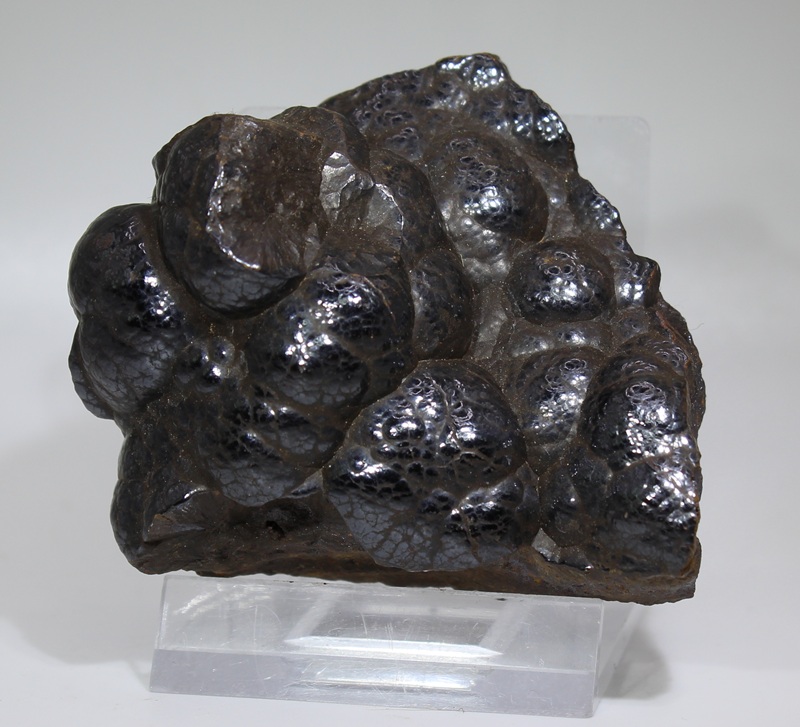
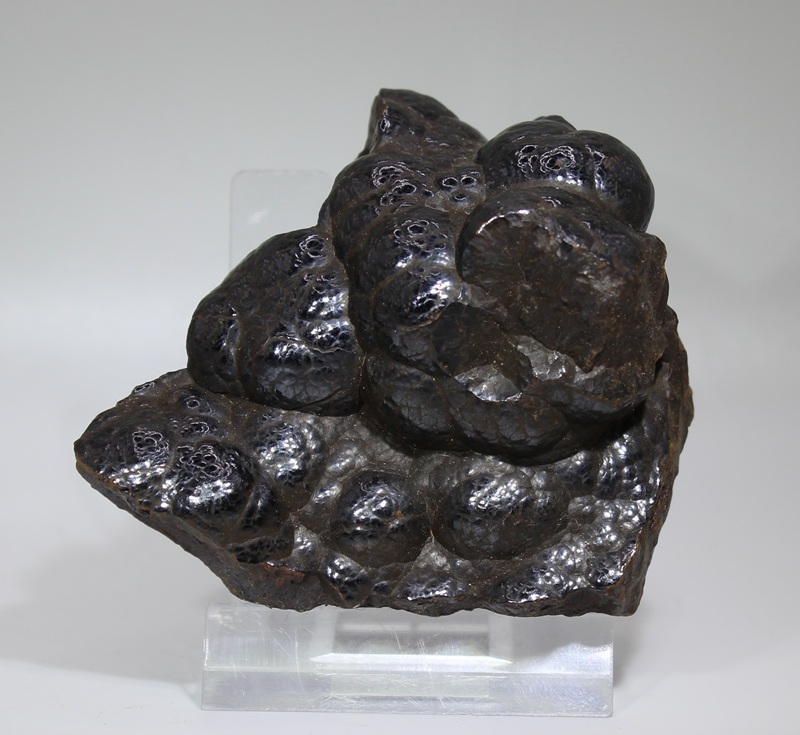
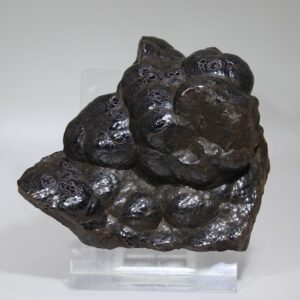
This goethite specimen comes from the mining area of Taouz in the Moroccan province of Errachidia. The goethite forms a continuous black surface composed of densely arranged, rounded to botryoidal aggregates.
Numerous smaller drusy areas occur between the larger rounded forms. Under direct light, the surfaces show a dull to submetallic luster. This type of formation is traditionally referred to in German as “Schwarzer Glaskopf.”
Measuring 6.3 × 5.7 × 3.5 cm, the piece belongs to the small cabinet specimen size category. It weighs 172 g.
Goethite from the Taouz Mining Area
The area around Taouz is known for a variety of mineralizations associated with hydrothermal vein systems. Goethite formed there as a secondary iron mineral through the oxidation and alteration of originally iron-bearing minerals. Botryoidal goethite aggregates, as well as associations with other ore minerals, are documented from the Taouz area.
The black color, distinctly structured surface, and compact formation make this specimen a characteristic example of goethite from Taouz.
| Feature | Details |
|---|---|
| Mineral | Goethite |
| Chemical composition | Iron(III) oxide hydroxide, α-FeO(OH) |
| Traditional German name | Schwarzer Glaskopf |
| Locality | Taouz, Errachidia Province, Drâa-Tafilalet, Morocco |
| Dimensions | 6.3 × 5.7 × 3.5 cm |
| Weight | 172 g |
| Specimen Size | Small Cabinet Specimen |
| Color | Black |
| Luster | Dull to submetallic |
| Aggregate form | Rounded to botryoidal, locally drusy |
| Formation | Secondary oxidation mineral |
| Special Feature | Botryoidal goethite from the Taouz mining area |
| Mineral | Goethite |
|---|---|
| Color | Black |
| Size | Small cabinet specimen (5-7 cm) |
| Continent | Africa |
| Country | Morocco |
Be the first to review “Botryoidal Goethite from Taouz, Morocco”
Related products


No VAT is shown in accordance with Section 19 (1) of the German VAT Act. Shipping costs apply.
plus shipping costs
No VAT is shown in accordance with Section 19 (1) of the German VAT Act. Shipping costs apply.
plus shipping costs
No VAT is shown in accordance with Section 19 (1) of the German VAT Act. Shipping costs apply.
plus shipping costs

No VAT is shown in accordance with Section 19 (1) of the German VAT Act. Shipping costs apply.
plus shipping costs
No VAT is shown in accordance with Section 19 (1) of the German VAT Act. Shipping costs apply.
plus shipping costs

No VAT is shown in accordance with Section 19 (1) of the German VAT Act. Shipping costs apply.
plus shipping costs
No VAT is shown in accordance with Section 19 (1) of the German VAT Act. Shipping costs apply.
plus shipping costs


No VAT is shown in accordance with Section 19 (1) of the German VAT Act. Shipping costs apply.
plus shipping costs
Reviews
There are no reviews yet.