


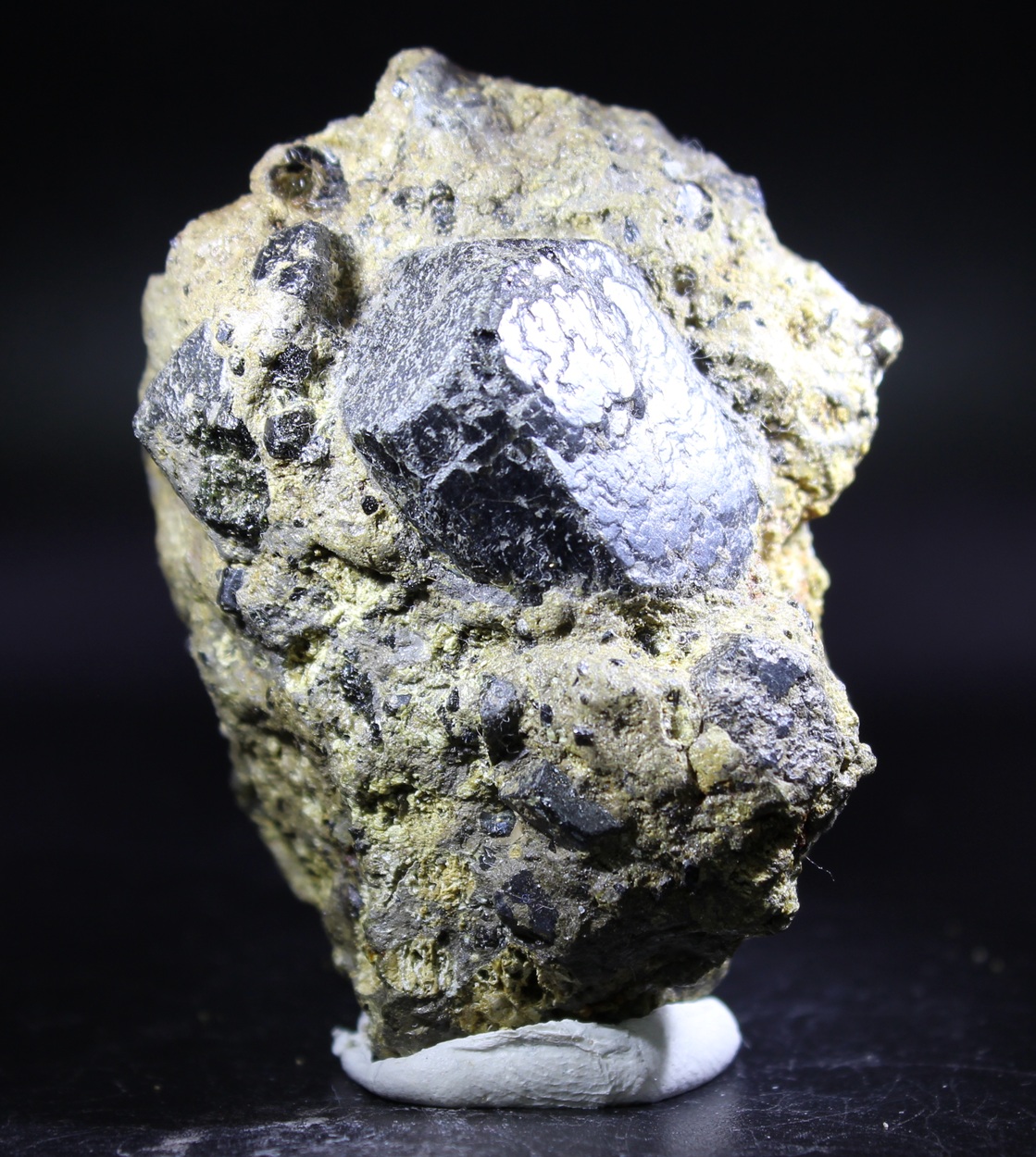
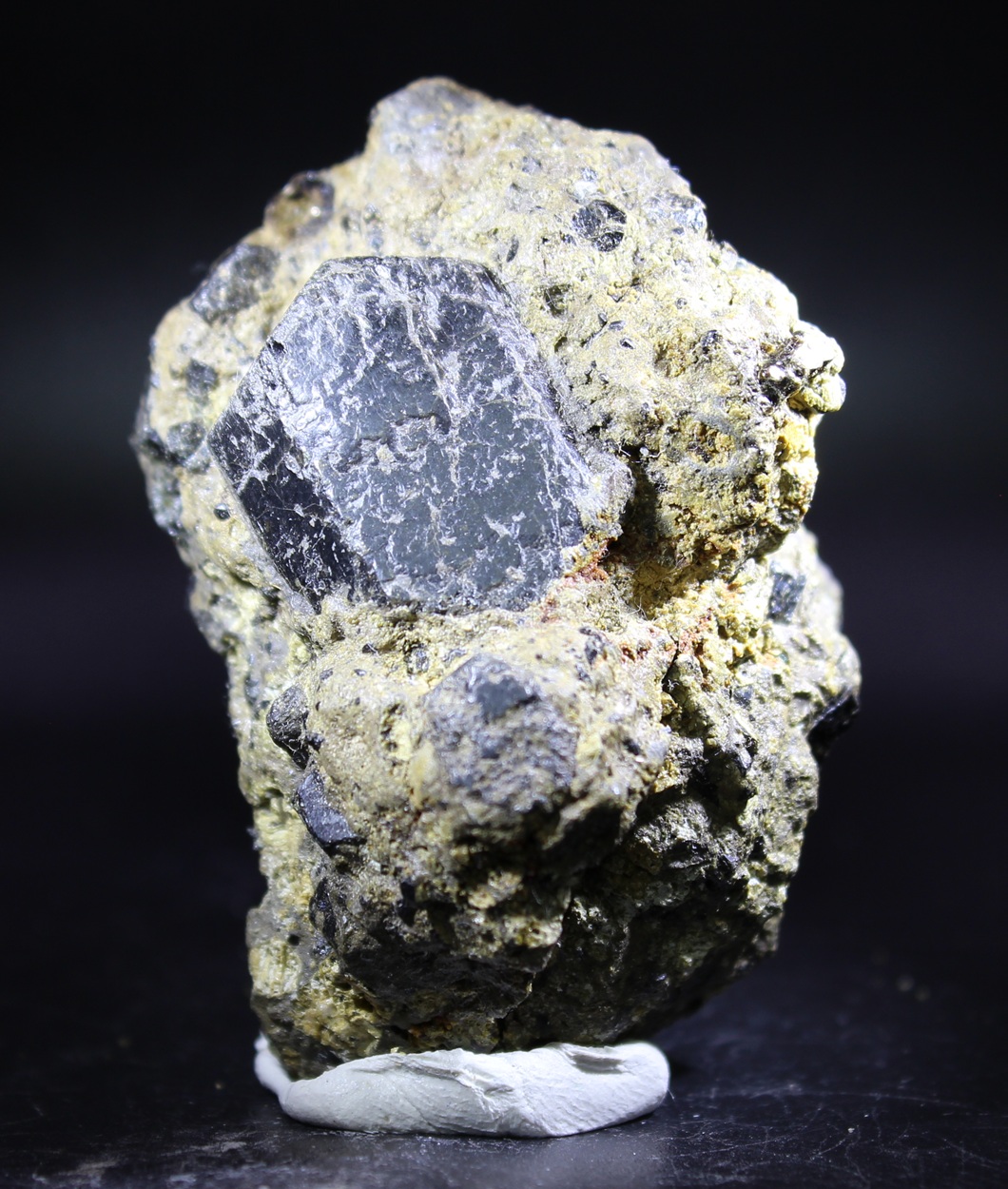



Diopside specimen from Paškapole near Bořislav in the Bohemian Central Highlands, Czech Republic. A prominent dark gray to black crystal and numerous smaller diopside crystals are embedded in a yellowish-green rock matrix. The large crystal on the display face is particularly striking.
Dark Diopside Crystals from Paškapole in the Bohemian Central Highlands
This diopside specimen originates from Paškapole near Bořislav in the Bohemian Central Highlands of the Czech Republic. The 5.2 cm specimen features a prominent dark gray to nearly black crystal projecting distinctly from the yellowish-green rock matrix. Numerous smaller diopside crystals are also present, embedded to varying degrees throughout several areas of the specimen.
The larger crystal on the display face is particularly notable. It has a stout, short-prismatic appearance with clearly recognizable bounding faces. Parts of its surface exhibit a pronounced luster, while other areas appear more matte and show irregular surface textures. Smaller crystals of similar dark coloration are partly exposed, with some revealing only individual faces at the rock surface.
The yellowish-green to grayish-green matrix has a rough, locally highly irregular texture. The dark diopside crystals create a striking color contrast against the lighter host rock. Several smaller crystals are also visible on the back of the specimen, allowing their occurrence within the volcanic rock to be observed from different perspectives.
Paškapole is one of the classic mineral localities of the Bohemian Central Highlands. The dark pyroxene crystals from this occurrence were historically identified as augite and are still listed under that name on many older mineral labels. However, mineralogical investigations and modern classification have led to these crystals being predominantly classified as diopside. The historical name augite therefore remains common among specimens from Paškapole.
Measuring 5.2 × 4 × 3.5 cm and weighing 79.3 g, this specimen is particularly interesting for collectors of the pyroxene group, volcanic mineral occurrences, and classic Czech mineral localities. Its prominent main crystal and numerous smaller diopside crystals make it a characteristic locality specimen from northern Bohemia.
| Mineral | Diopside |
|---|---|
| Color | Black |
| Size | Small cabinet specimen (5-7 cm) |
| Continent | Europe |
| Country | Czechia |
| Feature | Classic locality |
Be the first to review “Diopside – Paškapole, Czech Republic”
Related products
9. Silicates & Germanates
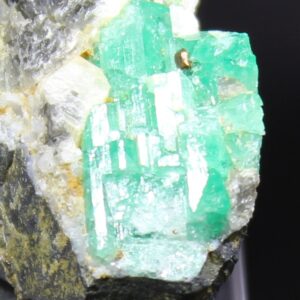
Emerald from Galería Los Topos, Chivor district – Crystal Group on Matrix
No VAT is shown in accordance with Section 19 (1) of the German VAT Act. Shipping costs apply.
plus shipping costs
9. Silicates & Germanates
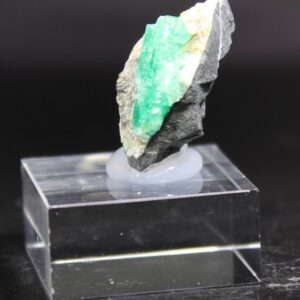
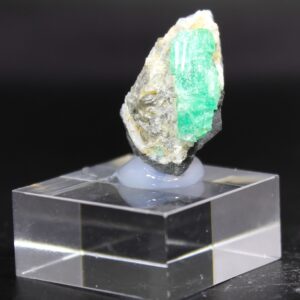
Emerald from Galería Los Topos, Chivor – 1.4 cm Crystal on Matrix
No VAT is shown in accordance with Section 19 (1) of the German VAT Act. Shipping costs apply.
plus shipping costs

9. Silicates & Germanates
No VAT is shown in accordance with Section 19 (1) of the German VAT Act. Shipping costs apply.
plus shipping costs
9. Silicates & Germanates
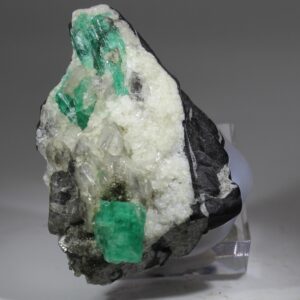
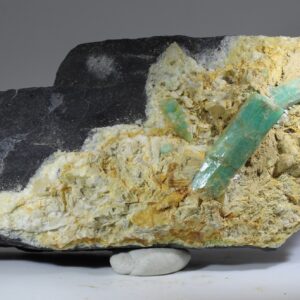
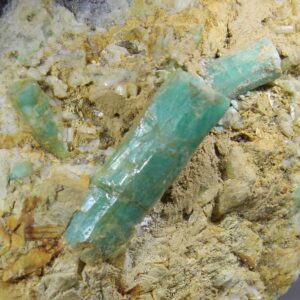
Emerald from the Chivor District, Colombia – Three Crystals on Large Matrix
No VAT is shown in accordance with Section 19 (1) of the German VAT Act. Shipping costs apply.
plus shipping costs


9. Silicates & Germanates
No VAT is shown in accordance with Section 19 (1) of the German VAT Act. Shipping costs apply.
plus shipping costs
7. Sulfates & Related Minerals
No VAT is shown in accordance with Section 19 (1) of the German VAT Act. Shipping costs apply.
plus shipping costs
9. Silicates & Germanates
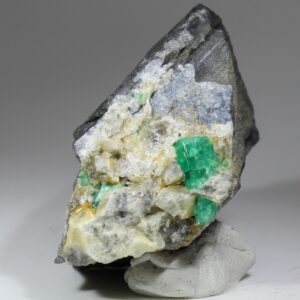
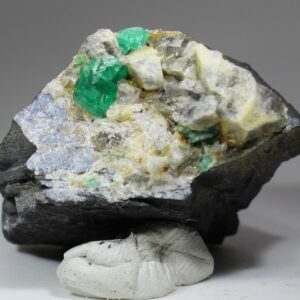
Emerald from Galería Los Topos, Chivor – Green Crystals on Matrix
No VAT is shown in accordance with Section 19 (1) of the German VAT Act. Shipping costs apply.
plus shipping costs
9. Silicates & Germanates
No VAT is shown in accordance with Section 19 (1) of the German VAT Act. Shipping costs apply.
plus shipping costs
Reviews
There are no reviews yet.