

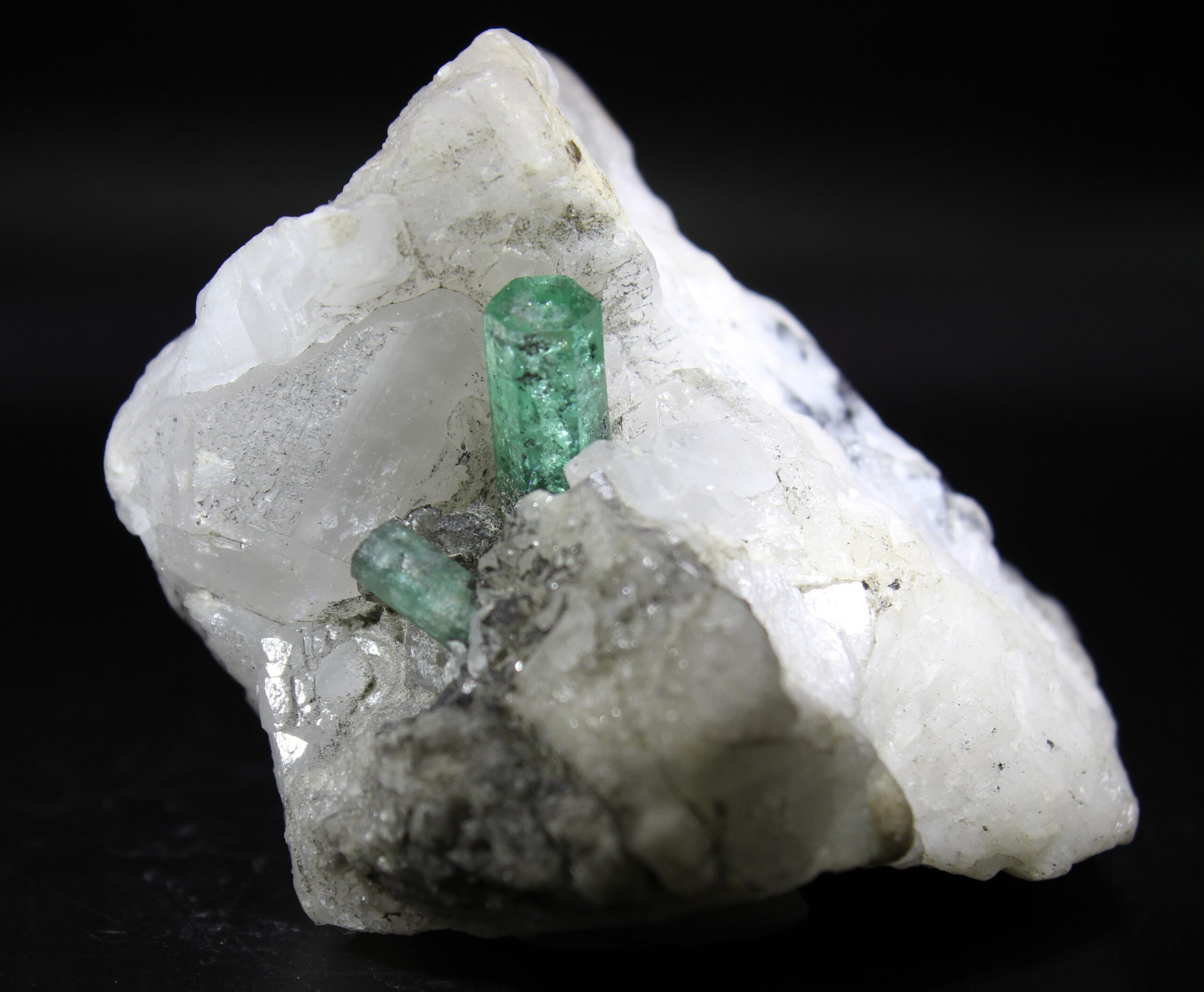
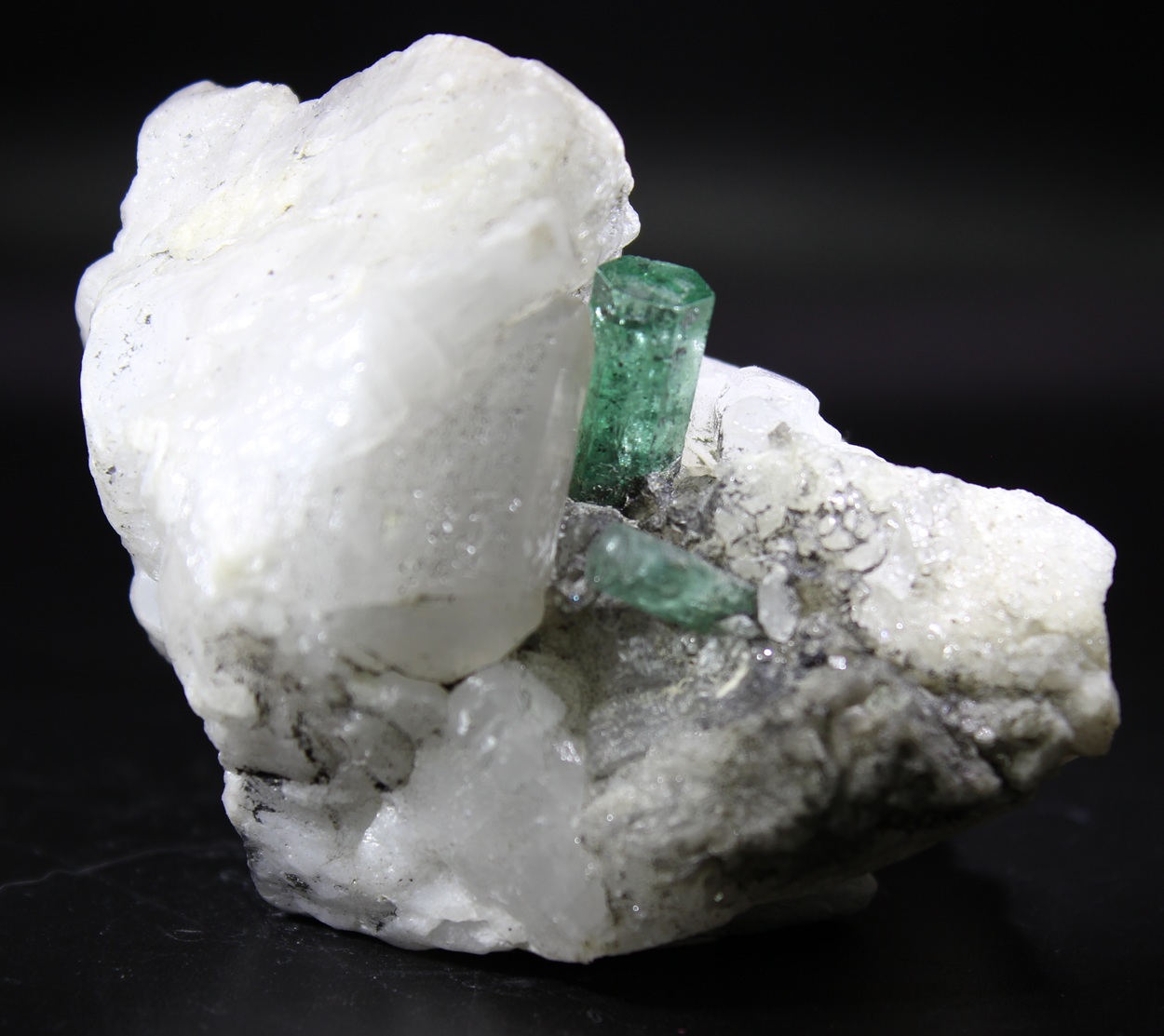

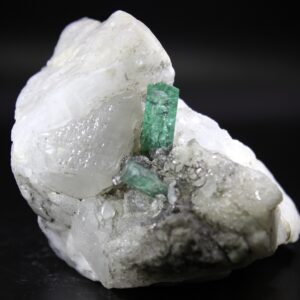
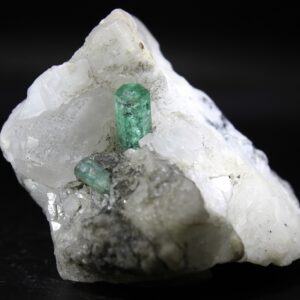
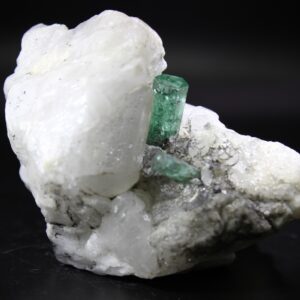
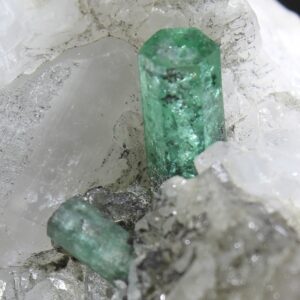
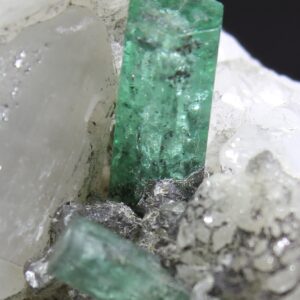
This impressive emerald specimen comes from the Coscuez district in Boyacá, Colombia, one of the classic localities of the western Colombian emerald belt. The specimen is dominated by a free-standing, completely intact emerald crystal estimated at approximately 1.8 to 2 cm in length. A second, smaller crystal measuring around 7 mm complements the specimen.
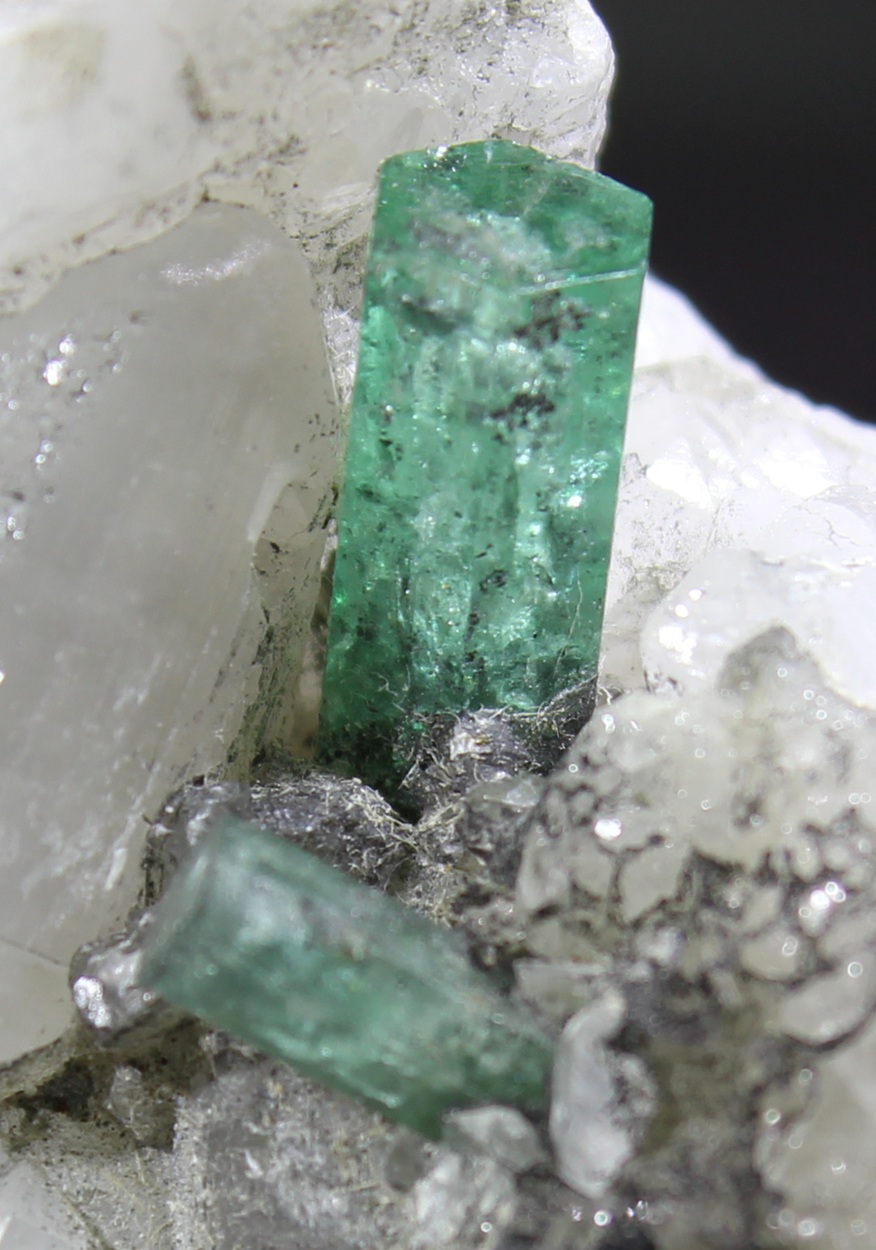
The main crystal shows a clearly prismatic habit with a well-developed natural termination. Its green colour contrasts strongly with the predominantly light-coloured carbonate matrix. Numerous natural inclusions and internal growth features are visible within the crystal, while it still retains good transparency and noticeable surface lustre.
Emerald with Calcite and Carbonate Vein Mineralization
The interplay between the green emerald crystals and the light-coloured hydrothermal vein mineralization is particularly attractive. Clearly crystallized calcite can be seen directly beside the emeralds. Other parts of the matrix consist of pale carbonate mineralization, locally accompanied by darker portions of the sedimentary host rock.
This combination is characteristic of many emerald specimens from Colombia’s western emerald belt. At Coscuez, emerald mineralization is closely associated with hydrothermal carbonate veins and breccias within Lower Cretaceous sedimentary rocks. Calcite is one of the typical associated minerals of the deposit.
A Completely Intact Main Crystal
The main appeal of this specimen lies in the undamaged principal crystal. It projects clearly from the matrix, allowing both the prismatic crystal body and the natural termination to be seen particularly well.
With overall dimensions of 7.5 × 6.5 × 4 cm, the specimen also provides a substantial matrix for the main crystal. This preserves the emerald within its natural geological context rather than presenting it as an isolated crystal. The smaller second emerald adds further depth and three-dimensional interest to the specimen.
Locality
The Coscuez district is one of Colombia’s historically most important emerald-producing areas. Located in western Boyacá, it is geologically closely related to the deposits of Muzo, while representing a distinct emerald deposit in its own right. Coscuez has been known for centuries for high-quality emeralds and remains one of Colombia’s classic emerald localities.
Learn more about the Coscuez district in Colombia’s western emerald belt, its geology, and my impressions from visiting the area in my detailed travel report on Colombia’s emerald regions.
| Feature | Description |
|---|---|
| Mineral | Emerald, variety of beryl |
| Locality | Coscuez district, Boyacá, Colombia |
| Dimensions | 7.5 × 6.5 × 4 cm |
| Weight | 226 g |
| Size category | Cabinet specimen |
| Color | vivid green to slightly bluish green |
| Transparency | Transparent to translucent, with clearly visible natural inclusions |
| Crystal habit | Free-standing prismatic main crystal with natural termination; additional smaller emerald crystal |
| Main Crystal | Estimated at approx. 1.8–2.0 cm long |
| Second Crystal | Approx. 7 mm |
| Matrix | Predominantly light-coloured carbonate vein mineralization with visible calcite crystals and darker host-rock components |
| Special Features | Completely intact main crystal, strong colour contrast with the matrix, classic Coscuez locality |
| Mineral | Emerald |
|---|---|
| Color | Green, White |
| Size | Cabinet specimen (7-10 cm) |
| Continent | South America |
| Country | Colombia |
| Feature | Acquired On Site, Classic locality |
Be the first to review “Emerald on Matrix from Coscuez, Colombia”
Related products
No VAT is shown in accordance with Section 19 (1) of the German VAT Act. Shipping costs apply.
plus shipping costs
No VAT is shown in accordance with Section 19 (1) of the German VAT Act. Shipping costs apply.
plus shipping costs
No VAT is shown in accordance with Section 19 (1) of the German VAT Act. Shipping costs apply.
plus shipping costs
No VAT is shown in accordance with Section 19 (1) of the German VAT Act. Shipping costs apply.
plus shipping costs

No VAT is shown in accordance with Section 19 (1) of the German VAT Act. Shipping costs apply.
plus shipping costs

No VAT is shown in accordance with Section 19 (1) of the German VAT Act. Shipping costs apply.
plus shipping costs
No VAT is shown in accordance with Section 19 (1) of the German VAT Act. Shipping costs apply.
plus shipping costs
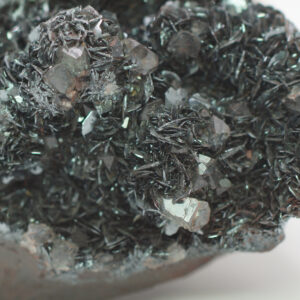
No VAT is shown in accordance with Section 19 (1) of the German VAT Act. Shipping costs apply.
plus shipping costs
Reviews
There are no reviews yet.